
AI Video Analytics · Platform Architecture
Every camera feed, one pipeline.
From pixels to decisions, in real time.
The Scanalitix architecture takes a raw RTSP stream and turns it into a validated, escalated, closed-out incident — without a person watching every screen. Ingest, edge inference, rules, alerts, and storage all run as one synchronized system.
8 processing layers
104 configurable rules
Offline-capable edge
Multi-channel alerting
How the Platform Is Built
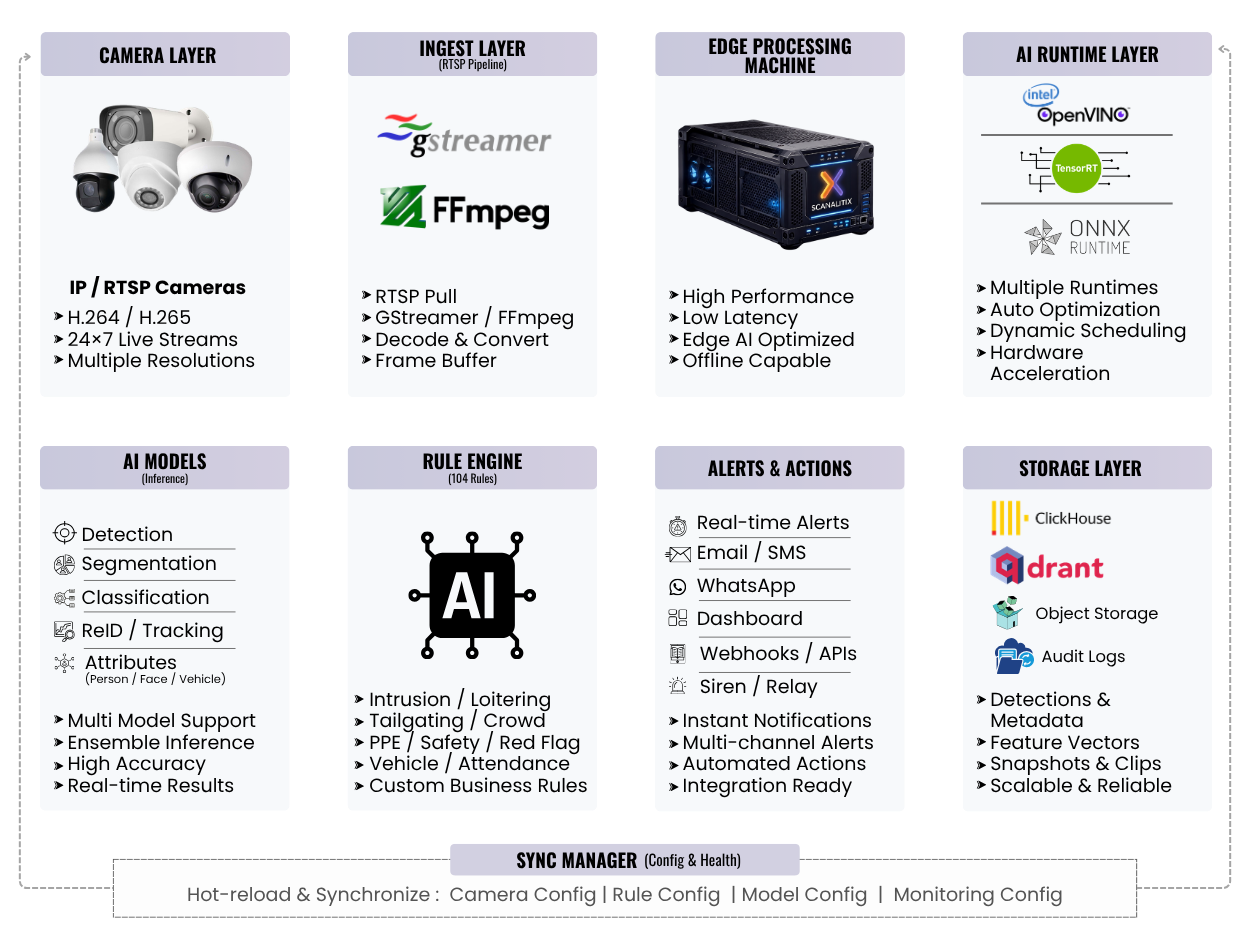
Eight layers, each doing one job well, kept in sync by a single configuration manager.

Camera Layer (IP / RTSP Cameras)
Any existing camera estate
H.264 / H.265 streams
24×7 live capture
Multiple resolutions, one setup

Ingest Layer (RTSP Pipeline)
GStreamer / FFmpeg
Pulls every stream reliably
Decodes & converts on the fly
Frame buffering absorbs network jitter

Edge Processing (Scanalitix Edge Machine)
On-site compute
Built for low-latency inference
Optimized for edge AI workloads
Keeps working if the internet doesn’t

AI Runtime (OpenVINO · TensorRT · ONNX)
Hardware-aware execution
Runs whichever runtime fits the hardware
Auto-optimizes models at load time
Schedules work across accelerators

AI Models (Detection to Attributes)
Detection · Segmentation · Classification · ReID/Tracking · Attributes
Multiple models run together, not in place of each other
Ensemble inference for fewer false positives
Person, face, and vehicle attributes in real time

Rule Engine (104 Configurable Rules)
Business logic, not hard-coded logic
Intrusion, loitering, tailgating, crowding
PPE, safety, and red-flag conditions
Vehicle and attendance rules, custom to the site

Alerts & Actions (Every Channel, One Trigger)
Email · SMS · WhatsApp · Webhooks · Siren/Relay
Instant, prioritized notifications
Dashboards and API/webhook delivery
Can trigger a physical response, not just a message

Storage Layer (ClickHouse · Qdrant · Object Storage)
Detections, vectors, clips, audit logs
Every detection and metadata point retained
Feature vectors for fast re-search
Snapshots, clips, and audit trail, at scale
How the Platform Is Built
Eight layers, each doing one job well, kept in sync by a single configuration manager.
How It Works
From the moment a camera sees something, to a resolved and reported incident.
Detect
AI-powered analytics monitor every stream continuously, identifying threats, anomalies, and operational events before they escalate.
01
Monitor
Centralized teams receive prioritized alerts through intelligent queues, AI tagging, and multi-level validation workflows.
02
Respond
Incidents are auto-routed through predefined, SLA-driven escalation — ensuring the right person acts at the right time.
03
Execute
Field teams receive assignments, perform corrective actions, and verify closure through geo-tagged, timestamped service records.
04
Report
Dashboards and reports deliver visibility into performance, SLA compliance, alert trends, and operational health — across every site.
05
Why This Architecture
Built to hold up under real sites, real network conditions, and real alert volume.

Real-time, edge-first processing

Multi-model accuracy, fewer false alerts

Keeps running through network outages

104 rules, tuned to your site

Alerts on the channel your team actually uses
Scalable storage, searchable history
See the Architecture in Action
Walk through a live deployment — camera to alert to closed incident — with our team.