
Why Fragmented Monitoring Tools Fail Large-Scale Infrastructure
Are You Really Seeing Your Infrastructure or Just Pieces of It?
If modern infrastructure is more observable than ever, why do outages still catch enterprises off guard?
Why do operations teams feel overwhelmed despite dashboards everywhere?
And why does “more monitoring” often result in less clarity?
The uncomfortable answer lies in Fragmented Monitoring Tools.
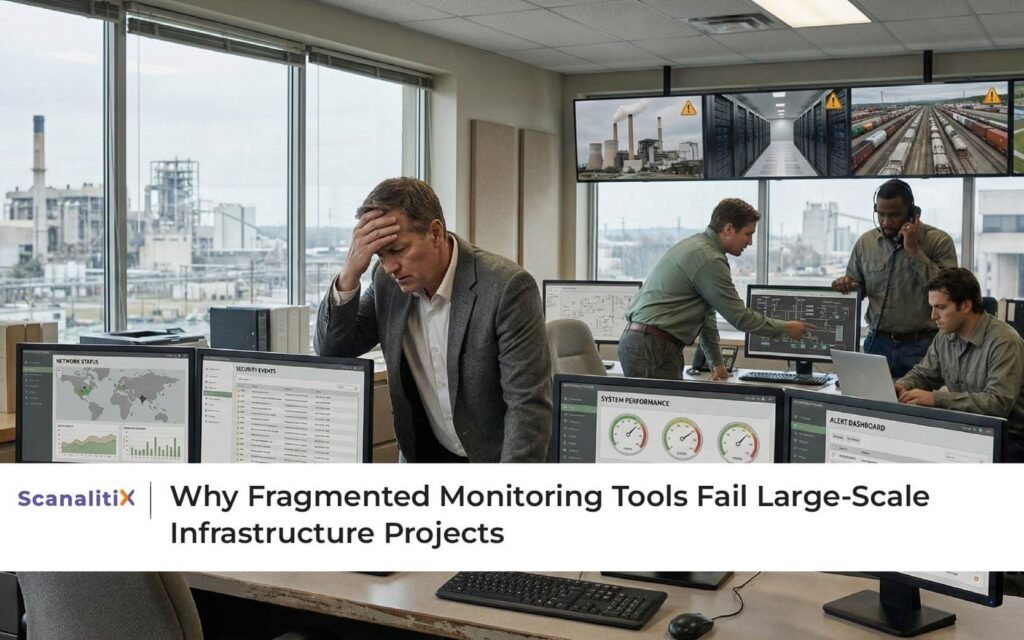
As infrastructure scales across cloud, edge, data platforms, applications, and security layers, enterprises rarely rely on a single monitoring solution. Instead, they accumulate tools—each solving a narrow problem, each producing its own alerts, metrics, and dashboards. Over time, Fragmented Monitoring Tools don’t just complicate visibility—they actively undermine it.
The Illusion of Control Created by Fragmented Monitoring Tools
On paper, having multiple monitoring tools sounds thorough. In reality, Fragmented Monitoring Tools create an illusion of control while hiding systemic risk.
Each tool monitors its own domain:
Infrastructure metrics in one place
Application performance in another
Logs somewhere else
Security alerts in their own silo
What’s missing is context.
When a failure occurs, teams must jump between tools, manually correlate signals, and reconstruct timelines. Fragmented Monitoring Tools turn every incident into a detective exercise—costly, slow, and error-prone.
Tool Sprawl Isn’t an Exception—It’s the Norm
This isn’t a fringe problem limited to overgrown IT environments.
In a 2024 observability industry survey, organizations reported using 62 different monitoring and observability technologies, a clear indicator of extreme tool sprawl. The same survey revealed that 70% of teams rely on four or more observability tools concurrently, making correlation, context, and unified alerting significantly harder.
At scale, Fragmented Monitoring Tools are no longer manageable through human effort alone.
Why Fragmented Monitoring Tools Break at Enterprise Scale
1. Correlation Becomes Manual and Slow
Modern incidents rarely originate from a single component. A minor configuration change can ripple across infrastructure, applications, and data pipelines. With Fragmented Monitoring Tools, signals remain isolated.
Teams spend more time correlating alerts than resolving issues. Root cause analysis slows down, and mean time to recovery stretches longer with every additional tool.
2. Alert Fatigue Is Baked In
Each monitoring tool has its own alert logic. Multiply that across platforms, and alert noise becomes unavoidable.
Fragmented Monitoring Tools flood teams with symptoms, not causes. Engineers stop trusting alerts altogether—or worse, miss the critical ones.
At scale, alert fatigue isn’t just inefficient; it’s dangerous.
3. Observability Turns Reactive Instead of Predictive
True observability should answer:
What’s about to fail?
Why is risk increasing?
But Fragmented Monitoring Tools are designed to report what already happened. Without unified data and intelligence, prediction is nearly impossible.
Enterprises remain stuck in reactive firefighting, even with sophisticated tooling.
Fragmented Monitoring Tools vs. Modern Infrastructure Reality
Today’s infrastructure is:
Distributed
Cloud-native
Event-driven
Constantly changing
Yet Fragmented Monitoring Tools are static by design. They were never built to understand dynamic dependencies, ephemeral workloads, or real-time data flows.
As systems scale, the gap between infrastructure complexity and monitoring capability widens—until failure becomes inevitable.
The Hidden Cost of Fragmented Monitoring Tools
The most damaging impact of Fragmented Monitoring Tools isn’t technical-it’s organizational.
- Teams operate in silos
- Ownership becomes unclear
- Incidents trigger blame instead of insight
- Decision-making slows under uncertainty
Over time, enterprises normalize instability. Downtime becomes “expected.” Resilience becomes aspirational.
Why Adding Another Tool Makes Things Worse
When monitoring gaps appear, the instinctive response is to add yet another tool. Ironically, this accelerates failure.
Every new tool increases:
- Data silos
- Alert volume
- Integration complexity
Instead of solving blind spots, Fragmented Monitoring Tools multiply them.
The problem isn’t a lack of tools-it’s a lack of unified intelligence.
What Enterprises Actually Need (But Rarely Build)
To overcome Fragmented Monitoring Tools, large-scale infrastructure needs:
- Unified observability across infrastructure, applications, data, and security
- Context-aware correlation, not static thresholds
- Real-time intelligence, not delayed dashboards
- Automated response, not manual escalation
This isn’t about replacing teams-it’s about removing noise so teams can focus on what matters.
How Scanalitix Makes Monitoring Work at Scale
Instead of isolated dashboards, Scanalitix enables a Unified E-Surveillance Ecosystem that provides:
- Centralized visibility across distributed systems
- AI-driven correlation of events and behaviors
- Real-time detection of anomalies and risk patterns
- Actionable insights instead of raw alerts
By breaking down silos created by Fragmented Monitoring Tools, Scanalitix transforms monitoring into a Unified E-Surveillance Ecosystem, helping enterprises shift from reactive monitoring to proactive, intelligence-led operations.
The Result
Fewer false positives
Faster root-cause identification
Reduced operational noise
Greater confidence in system behavior
Monitoring becomes a strategic capability-not an operational burden.
From Monitoring to Intelligence: The Real Shift
The future isn’t about eliminating tools-it’s about eliminating fragmentation.
As infrastructure grows more complex, Fragmented Monitoring Tools will fail faster and more visibly. Enterprises that succeed will be those that invest in intelligence, correlation, and automation-rather than more dashboards.
Future Outlook: Life After Fragmented Monitoring Tools
Looking ahead, monitoring will evolve into:
-
Self-learning systems that adapt to change
-
Predictive platforms that surface risk early
-
Self-healing environments that resolve issues automatically
In this future, Fragmented Monitoring Tools won’t just be inefficient—they’ll be obsolete.
The question is no longer if enterprises should move beyond fragmentation.
It’s how long they can afford not to.