
The Governance Paradox: Can You Be Everywhere Without Losing Control?
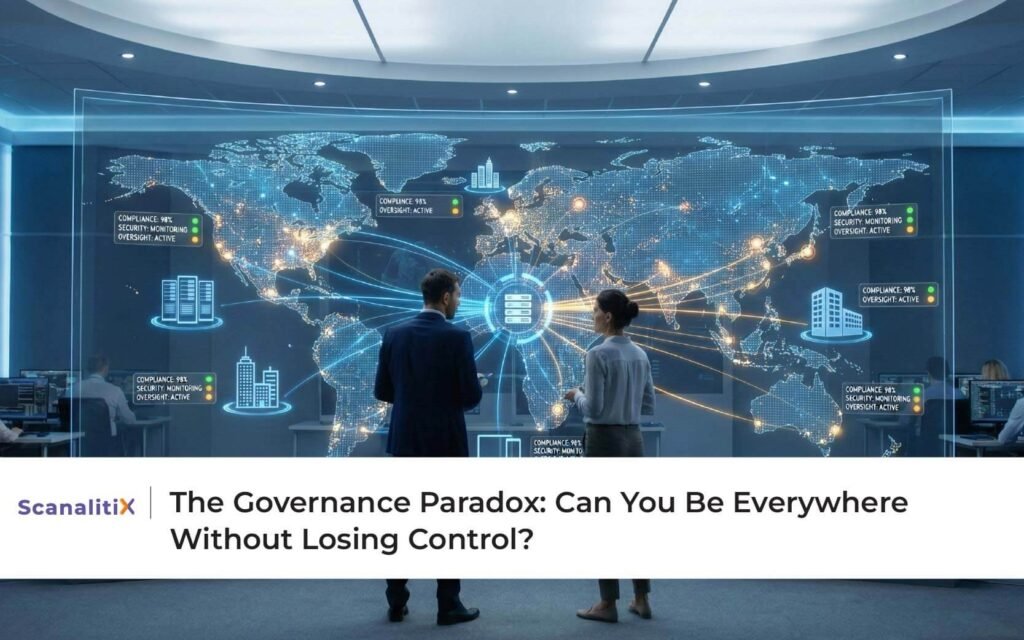
What happens when your enterprise grows faster than your ability to oversee it?
When new sites come online, operations spread across geographies, and decision-making becomes increasingly decentralized—does control naturally weaken? Or can scale and control coexist?
This is the governance paradox facing modern enterprises today. As organizations expand, they must be present everywhere while still maintaining consistent security, compliance, and operational visibility. The challenge isn’t just expansion-it’s doing so without fragmenting oversight. This is where Multi-Site Governance moves from being an operational concern to a strategic imperative.
Why Governance Becomes Harder as Enterprises Scale
Growth rarely happens in neat, linear steps. New offices, plants, campuses, warehouses, or partner locations are often added quickly to meet demand or enter new markets. Each site brings its own teams, local practices, regulatory interpretations, and infrastructure constraints.
Over time, governance becomes uneven. Policies are applied differently. Monitoring tools multiply. Visibility weakens.
The numbers reinforce this reality:
- 69% of organizations say regulatory requirements are too complex or too numerous, making centralized Multi-Site Governance crucial.
- 82% of businesses say increasing compliance complexity negatively impacts transformation and change efforts.
When compliance complexity slows innovation, and visibility gaps widen, governance stops being a safeguard and starts becoming a bottleneck.
The Core Tension: Central Control vs. Local Autonomy
Distributed enterprises live in a constant balancing act. On one side lies centralized control—uniform policies, standardized security, consistent compliance. On the other lies local autonomy—the flexibility to adapt to site-specific needs, regional regulations, and operational realities.
Rigid centralization can stifle agility. Excessive decentralization can dilute accountability.
Multi-Site Governance exists precisely to resolve this tension. It enables enterprises to define global standards while allowing local teams to operate efficiently within those guardrails. The goal isn’t control for control’s sake—it’s clarity, consistency, and confidence at scale.
Why Visibility Is the Foundation of Multi-Site Governance
You cannot govern what you cannot see.
As enterprises scale, fragmented monitoring becomes one of the biggest risks. Disparate surveillance systems, siloed dashboards, and manual reporting make it nearly impossible to understand what’s happening across all sites in real time.
Effective Multi-Site Governance depends on real-time visibility that answers critical questions instantly:
- Are security policies being followed across locations?
- Are compliance gaps emerging anywhere?
- Are incidents isolated—or systemic?
Without unified visibility, governance becomes reactive. With it, governance becomes proactive.
Automation: The Missing Link in Scalable Governance
Manual governance processes do not scale. As sites multiply, so do audits, reports, incident logs, and compliance checks. Human-led oversight quickly becomes unsustainable.
Automation changes the equation.
By embedding automated rules, alerts, and workflows into governance frameworks, enterprises can enforce standards consistently without increasing operational overhead. Automated governance ensures that:
- Policies are applied uniformly across sites
- Exceptions are flagged immediately
- Compliance is continuous, not episodic
This shift is critical for modern Multi-Site Governance, especially as regulatory expectations continue to rise.
The Market Signals a Governance Transformation
The urgency around governance is reflected in market growth. The global enterprise governance, risk, and compliance (eGRC) market was valued at approximately USD 62.9 billion in 2024 and is projected to nearly double to USD 134.9 billion by 2030, growing at a CAGR of ~13.2% from 2025 to 2030.
This growth signals a clear shift: enterprises are no longer treating governance as a compliance exercise alone. They are investing in governance as a strategic capability that supports expansion, resilience, and trust.
How Scanalitix Is Redefining Multi-Site Governance
This is where Scanalitix enters the picture.
Scanalitix’s unified e-surveillance platform is designed specifically for distributed enterprises struggling with governance complexity. Instead of managing separate systems for each site, Scanalitix brings everything together under a single, intelligent framework.
Here’s how it strengthens Multi-Site Governance:
Centralized Oversight Without Micromanagement
Scanalitix enables enterprises to define governance policies centrally while allowing sites to operate independently within approved parameters. This preserves autonomy without sacrificing consistency.
Real-Time, Cross-Site Visibility
A unified dashboard provides live insights across all locations—security events, compliance signals, and operational anomalies—ensuring leaders are never blind to what’s happening on the ground.
Automated Controls and Alerts
Built-in automation enforces governance rules continuously. Deviations trigger alerts instantly, reducing response times and minimizing risk exposure.
Scalability by Design
As new sites are added, governance frameworks extend seamlessly. Expansion no longer means multiplying complexity—it means extending intelligence.
By integrating surveillance, analytics, and governance into one ecosystem, Scanalitix transforms Multi-Site Governance from a reactive burden into a proactive advantage.
From Fragmentation to Confidence at Scale
Enterprises that lack unified governance often experience the same symptoms:
- Inconsistent security posture
- Audit fatigue
- Delayed incident response
- Limited trust in reported data
Strong Multi-Site Governance reverses this dynamic. It creates confidence—not just for leadership, but for regulators, partners, and customers. Governance becomes an enabler of scale rather than a constraint on growth.
The Future of Governance in Distributed Enterprises
Looking ahead, governance will only grow more complex. Enterprises will operate across more locations, face tighter regulations, and manage increasingly intelligent systems. The question won’t be whether governance is necessary—but whether it’s adaptive enough.
The future of Multi-Site Governance lies in platforms that combine:
- Centralized intelligence
- Real-time visibility
- Automated enforcement
- Scalable architecture
Organizations that invest early in unified governance frameworks will expand faster, respond quicker, and operate with greater trust.
So, can you be everywhere without losing control?
With the right approach to Multi-Site Governance, the answer is no longer a paradox—it’s a strategic advantage.
Top of Form
Bottom of Form