
Surveillance on the Move - How AI Keeps Supply Chains Secure and Efficient
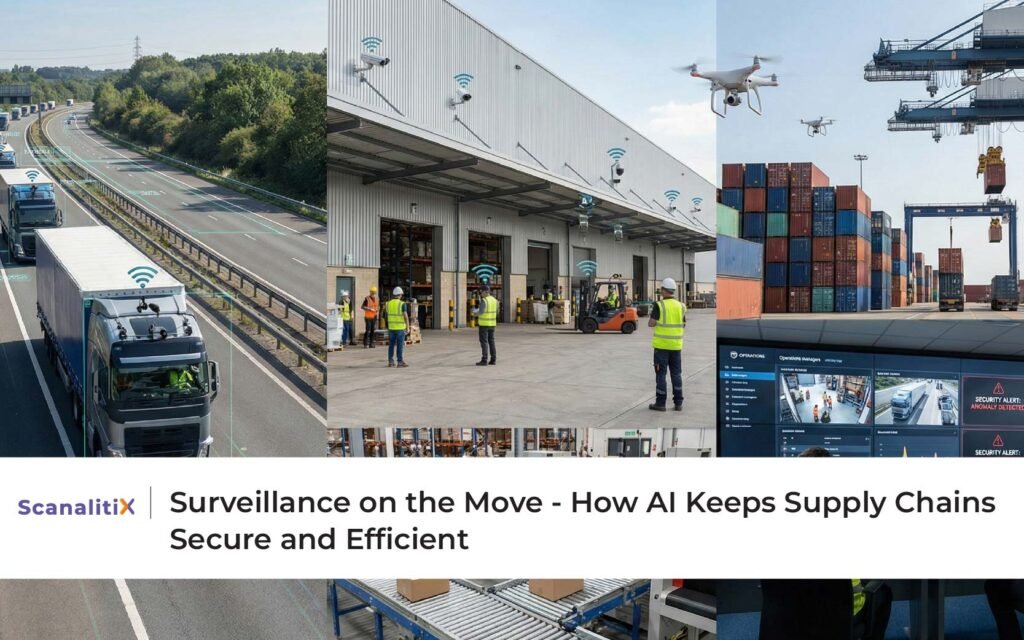
Table of Contents
Modern supply chains are no longer linear. They are dynamic, distributed, and constantly in motion. Goods travel across factories, warehouses, highways, ports, and retail hubs before reaching the end customer. At every stage, visibility matters. Yet for years, supply chain security relied on fragmented CCTV systems, manual checks, and reactive investigations after something went wrong.
Today, that approach is no longer enough.
As supply chains expand and risks grow more complex, organizations are turning to AI-powered surveillance and video analytics to secure operations and improve efficiency at the same time. Surveillance is no longer static. It moves with the supply chain, offering real-time intelligence across locations, vehicles, and facilities.
This shift is redefining how logistics and supply chain leaders think about safety, loss prevention, and operational performance.
Why Supply Chains Are Increasingly Vulnerable
Supply chains face a unique combination of physical and operational risks. Cargo theft, pilferage, unauthorized access, safety incidents, and delays can occur anywhere between origin and destination. According to the Transported Asset Protection Association (TAPA), global cargo theft losses run into billions of dollars annually, with incidents increasing in both frequency and sophistication.
At the same time, supply chains operate under intense pressure to deliver faster, cheaper, and more reliably. Warehouses run 24×7. Fleets move across long distances. Third-party vendors and contract workers access facilities daily. These factors create blind spots that traditional surveillance systems struggle to cover.
What makes the challenge even harder is scale. A logistics network may include hundreds of warehouses, thousands of vehicles, and multiple partners. Monitoring each node independently leads to fragmented visibility. AI-powered surveillance solves this by creating a unified, intelligent view of the entire supply chain.
From Cameras to Intelligence: How AI Changes Surveillance
Traditional surveillance records footage. AI-powered surveillance interprets it.
With computer vision and machine learning, modern systems understand what is happening in a scene rather than just capturing it. Cameras become sensors that detect patterns, anomalies, and risks in real time.
In supply chains, this intelligence plays a crucial role. AI can identify unusual activity in warehouses, detect unauthorized access to loading bays, monitor vehicle movement, and even recognize unsafe behavior on the shop floor. Instead of relying on manual monitoring, organizations receive contextual alerts that demand immediate attention.
According to a McKinsey report on supply chain digitization, companies that adopt AI-driven visibility tools can reduce operational losses and disruptions by 20–30 percent, while improving responsiveness across logistics operations.
This transformation allows surveillance to move from being reactive to being predictive.
Securing Warehouses and Distribution Centers
Warehouses are the backbone of modern supply chains. They store high-value inventory, operate with minimal downtime, and rely heavily on people, machines, and vehicles moving in close coordination.
AI-powered video analytics enhances warehouse security in several ways. It monitors entry and exit points to prevent unauthorized access. It detects tailgating at restricted doors and flags suspicious loitering near sensitive zones. It also tracks inventory movement to identify pilferage or deviation from standard processes.
Beyond theft prevention, AI improves safety. It can detect unsafe forklift operations, workers entering hazardous zones without protective gear, or spills that may cause accidents. The National Safety Council has reported that workplace injuries cost organizations billions annually, much of which could be prevented through early detection and intervention.
With AI surveillance, warehouse managers gain real-time insights that help them act before minor issues turn into costly incidents.
Surveillance on the Road: Fleet and In-Transit Monitoring
Supply chain surveillance does not stop at the warehouse gate. Once goods are in transit, visibility becomes even more critical.
AI-enabled cameras installed in vehicles or integrated with telematics systems allow organizations to monitor cargo movement, driver behavior, and route adherence. These systems can detect unusual stoppages, route deviations, or tampering attempts in real time.
In regions where cargo theft is common, such intelligence is invaluable. According to reports by BSI and TT Club, many cargo theft incidents occur during transit, especially at unsecured parking locations. AI-driven monitoring helps logistics teams intervene early by alerting control centers when anomalies occur.
In addition, driver-facing analytics promote safety and efficiency. AI can detect fatigue, distraction, or aggressive driving, helping companies reduce accidents and insurance costs. Over time, these insights contribute to better driver training and improved fleet performance.
Ports, Yards, and High-Risk Transit Zones
Ports, container yards, and cross-docking facilities represent some of the most complex supply chain environments. They involve multiple stakeholders, high cargo volumes, and continuous activity.
AI surveillance supports these environments by monitoring container movement, identifying unauthorized access to restricted areas, and tracking dwell times. Prolonged dwell time often signals inefficiencies or potential security risks. By flagging such anomalies, AI helps optimize throughput and reduce congestion.
A study by the World Economic Forum highlights that digital technologies, including AI and video analytics, can improve port efficiency by up to 25 percent, while also strengthening security and compliance.
In these high-risk zones, centralized monitoring becomes critical. Instead of relying on isolated security teams, organizations can operate unified command centers that oversee multiple locations in real time.
Improving Efficiency Through Visual Intelligence
While security is a major driver, AI-powered surveillance also delivers significant efficiency gains.
Video analytics provides insights into process bottlenecks, idle time, congestion, and workforce utilization. For example, heatmaps can show underused storage areas, while movement analysis can reveal inefficiencies in picking and packing workflows.
According to a Deloitte study on intelligent logistics, companies that leverage AI-based operational visibility experience faster order fulfillment, reduced delays, and improved service levels. Surveillance data, when analyzed correctly, becomes a powerful operational intelligence tool.
This dual benefit, security plus efficiency, makes AI surveillance a strategic investment rather than a cost center.
Unified Monitoring Across the Supply Chain
One of the biggest advantages of AI-powered surveillance is the ability to centralize monitoring across a distributed network.
A unified monitoring platform brings together feeds from warehouses, yards, vehicles, and partner locations into a single dashboard. Alerts are prioritized based on severity, and incidents are tracked from detection to resolution.
This approach improves coordination between security teams, operations managers, and field staff. It also creates a consistent security and compliance framework across geographies.
Research from Gartner indicates that organizations with centralized supply chain visibility platforms respond to disruptions 50 percent faster than those operating in silos.
In a world where delays can ripple across the entire supply chain, speed matters.
Trust, Compliance, and the Human Factor
Supply chains involve multiple partners, vendors, and third-party operators. Trust and compliance are essential.
AI-powered surveillance supports compliance by maintaining detailed audit trails, video evidence, and incident logs. This is particularly important in regulated industries such as pharmaceuticals, food, and electronics, where chain-of-custody and safety standards are critical.
Importantly, modern surveillance systems are designed with privacy and ethics in mind. The focus is on behavior and process, not intrusive monitoring. Clear governance, access controls, and data policies ensure responsible use.
When deployed correctly, surveillance enhances trust rather than eroding it.
The Road Ahead: Predictive and Autonomous Supply Chains
The future of supply chain surveillance lies in prediction. As AI models mature, systems will not only detect incidents but anticipate them.
By combining video analytics with IoT sensors, GPS data, and historical patterns, organizations can forecast risk zones, predict congestion, and optimize routes before disruptions occur. This vision aligns with the broader trend of autonomous and self-healing supply chains.
According to the World Economic Forum, AI-driven supply chains will be more resilient, adaptive, and transparent, qualities that are increasingly vital in a volatile global environment.
Conclusion
Supply chains never stand still. Goods move continuously across borders, facilities, and networks. To secure and optimize this movement, surveillance must move as well.
AI-powered surveillance transforms traditional security into a dynamic intelligence layer that travels with the supply chain. It protects assets, safeguards people, reduces losses, and unlocks operational efficiency.
In a world where speed, reliability, and resilience define competitive advantage, visual intelligence has become indispensable. Surveillance on the move is no longer optional. It is the foundation of secure and efficient supply chains.