
One Platform, Many Use Cases: How Unified E-Surveillance Scales Across Industries
E-surveillance is no longer confined to security rooms filled with screens. It has evolved into a strategic layer of intelligence that powers safety, efficiency, and decision-making across industries. From banks and retail stores to smart cities and logistics hubs, organizations are rethinking how they monitor and manage their environments.
At the center of this transformation is unified e-surveillance, a model that integrates video management, AI-powered video analytics, centralized monitoring, and operational workflows into a single platform. Instead of operating fragmented systems for different functions, organizations are moving toward unified platforms that scale across use cases. The shift is not just technological. It reflects a broader realization: visibility becomes valuable only when it is connected, contextual, and actionable. 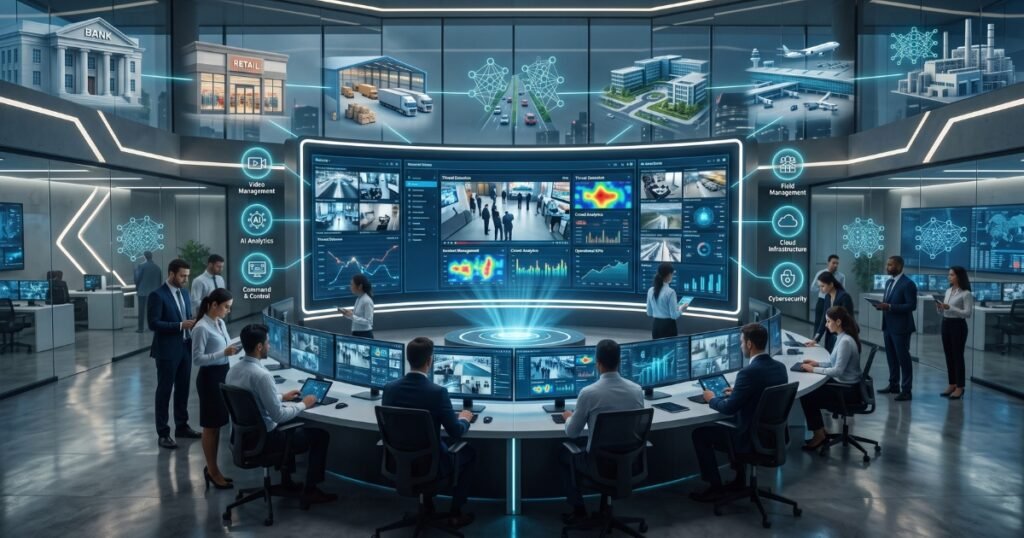
Why Fragmented Surveillance Systems Fall Short
Historically, surveillance systems were deployed in silos. CCTV systems handled recording. Access control systems managed entry points. Alarm systems triggered alerts. Monitoring teams operated independently across locations. While this setup served basic needs, it created several challenges. Data remained disconnected. Alerts lacked context. Response times increased because systems could not communicate effectively. Scaling operations across multiple locations required duplicating infrastructure and manpower.
According to Deloitte’s research on intelligent operations, organizations that rely on siloed monitoring systems often face delays in incident response and higher operational costs due to inefficiencies. The absence of integration limits the ability to derive insights from data.
In today’s fast-moving environments, fragmented surveillance is no longer sustainable. Organizations need a unified approach that brings all elements together.
What Unified E-Surveillance Really Means
Unified e-surveillance combines multiple capabilities into a single ecosystem. It integrates:
- Video Management Systems (VMS) for centralized control of camera feeds
- AI-powered video analytics for real-time detection and insights
- Integrated Command and Control Center (ICCC) for alert management and decision-making
- Field Management Systems (FMS) for on-ground response and closure
This integration creates a seamless flow from detection to action. Video feeds are not just recorded; they are analyzed. Alerts are not just generated; they are prioritized and resolved.
According to MarketsandMarkets, the global video analytics market is expanding rapidly as organizations adopt AI-driven surveillance to improve accuracy, reduce false alarms, and enhance operational efficiency. Unified platforms enable this shift by turning surveillance into a continuous intelligence loop.
Scaling Across Industries: A Cross-Sector Advantage
One of the most powerful aspects of unified e-surveillance is its ability to scale across industries. While the core technology remains the same, its applications adapt to different environments.
Banking and Financial Services
Banks operate across multiple branches, ATMs, and remote locations. Security, compliance, and customer safety are critical. Unified surveillance helps monitor ATM activity, detect suspicious behavior, and ensure compliance with regulatory requirements. It also enables centralized monitoring across branches, improving consistency and reducing risk.
IBM reports that AI-driven analytics significantly enhance fraud detection and security monitoring in financial institutions, reducing false positives and improving response accuracy.
Retail and Customer Experience
Retail environments require both security and operational insight. Unified e-surveillance tracks footfall, analyzes customer behavior, and monitors store activity. AI-powered analytics help retailers optimize store layouts, reduce shrinkage, and improve customer experience. McKinsey highlights that data-driven retail operations can significantly improve sales performance and operational efficiency. Surveillance in retail is no longer just about preventing theft. It is about understanding customers and improving business outcomes.
Logistics and Supply Chain
Warehouses and logistics hubs operate in high-movement environments where safety and efficiency are critical. Unified surveillance monitors inventory movement, detects unauthorized access, and identifies operational bottlenecks. It also supports worker safety by detecting unsafe practices or hazardous conditions. The World Economic Forum emphasizes that digital technologies, including AI surveillance, improve supply chain resilience and reduce operational disruptions.
Smart Cities and Public Infrastructure
Cities rely on surveillance for traffic management, public safety, and emergency response. Unified platforms integrate data from cameras, sensors, and IoT devices into centralized command centers. AI analytics help manage traffic flow, monitor crowd density, and detect incidents in real time. According to the United Nations, urban populations are growing rapidly, increasing the need for scalable and intelligent infrastructure. Unified e-surveillance plays a key role in managing this complexity.
Corporate Workspaces and Campuses
Modern workplaces require safety, compliance, and operational efficiency. Unified surveillance systems monitor access control, detect workplace hazards, and ensure employee safety. They also provide insights into space utilization and operational workflows. As hybrid work models evolve, organizations need flexible systems that can adapt to changing occupancy patterns and security requirements.
From Monitoring to Intelligence: The Real Value
The true value of unified e-surveillance lies in its ability to transform monitoring into intelligence. Instead of simply capturing events, unified systems analyze patterns, identify trends, and provide actionable insights. This enables organizations to move from reactive responses to proactive decision-making. For example, recurring incidents in specific locations can be identified and addressed. Operational inefficiencies can be detected and optimized. Security risks can be mitigated before they escalate.
McKinsey research indicates that organizations leveraging data-driven insights across operations can improve productivity by up to 30 percent. Surveillance data, when integrated and analyzed effectively, contributes significantly to these gains.
The Role of AI in Making Surveillance Scalable
AI is the engine that makes unified e-surveillance scalable.Without AI, monitoring thousands of cameras across multiple locations would require extensive human effort. AI automates detection, reduces false alarms, and highlights only meaningful events. Gartner predicts that AI-driven automation will play a central role in managing large-scale operations, particularly in environments with high data volume and complexity. By combining AI with centralized monitoring, organizations can achieve scale without compromising accuracy or efficiency.
Security, Governance, and Trust
As surveillance systems become more powerful, governance becomes critical. Unified platforms must ensure data security, privacy compliance, and transparent access controls. The European Commission’s guidelines on trustworthy AI emphasize the importance of accountability and ethical use in surveillance technologies. Organizations must balance intelligence with responsibility. Systems should focus on behavior and safety rather than intrusive monitoring. When deployed responsibly, unified e-surveillance enhances trust while delivering operational value.
Where Scanalitix Fits In
Scanalitix embodies the concept of unified e-surveillance by bringing together video management, AI analytics, centralized monitoring, and field operations into one cohesive platform.
It is designed to scale across industries without requiring separate systems for each use case. Whether monitoring a bank network, a retail chain, a logistics hub, or a smart city environment, Scanalitix adapts to the operational context while maintaining a consistent intelligence framework. By integrating real-time detection with structured workflows, it ensures that insights translate into action. Alerts are contextual, responses are tracked, and outcomes are measurable. Scanalitix does not treat surveillance as isolated functionality. It treats it as an integrated intelligence system that evolves with the organization.
Conclusion
Unified e-surveillance represents the future of monitoring in a connected world. As industries become more complex and distributed, the need for integrated, scalable, and intelligent systems becomes critical. One platform, when designed correctly, can serve multiple use cases across sectors. It can enhance safety, improve efficiency, and support better decision-making. The shift from fragmented systems to unified platforms is not just about technology. It is about unlocking the full value of data. In an era where visibility drives performance, unified e-surveillance ensures that organizations not only see more but understand better and act faster.