
Multi-Site Security at Scale: How Centralized Dashboards Improve Control
Why does security feel harder as organizations grow?
If security infrastructure is smarter than ever, why does managing it across locations still feel chaotic?
Every new office, warehouse, campus, or data center adds another layer of complexity. More cameras. More sensors. More alerts. More dashboards. And soon, security teams aren’t short on data-they’re drowning in it. What was once a manageable setup becomes fragmented, reactive, and alarm-driven instead of insight-led.
This is the core challenge of Multi-site security management today: how do you maintain control, consistency, and speed when your security ecosystem spans multiple locations, technologies, and teams?
The answer increasingly lies in centralization-not just of data, but of intelligence, visibility, and decision-making.
The growing pressure on multi-location security operations
Modern enterprises rarely operate from a single location. Retail chains, logistics hubs, smart cities, manufacturing plants, and enterprise campuses all run multi-location security operations that must remain synchronized despite geographic spread.
Yet, most organizations still manage security in silos:
- Separate systems per site
- Local teams interpreting alerts independently
- Manual escalation paths
- Delayed responses due to fragmented visibility
This fragmentation is no longer sustainable. Security threats today are faster, more coordinated, and often cross-site by nature. A breach, intrusion, or operational anomaly rarely stays confined to one location.
That’s why it’s no surprise that 81% of enterprise buyers say AI/ML capabilities in security platforms are important to their purchasing decisions. The expectation is clear: security platforms must do more than collect data—they must connect dots across sites, systems, and timelines.
Why centralized dashboards are becoming the backbone of enterprise security
As enterprises scale, so do their expectations from security systems. The market reflects this shift clearly large enterprises accounted for ~55.6% of the global SIEM market in 2024, underscoring how centralized platforms are becoming essential for enterprise security management.
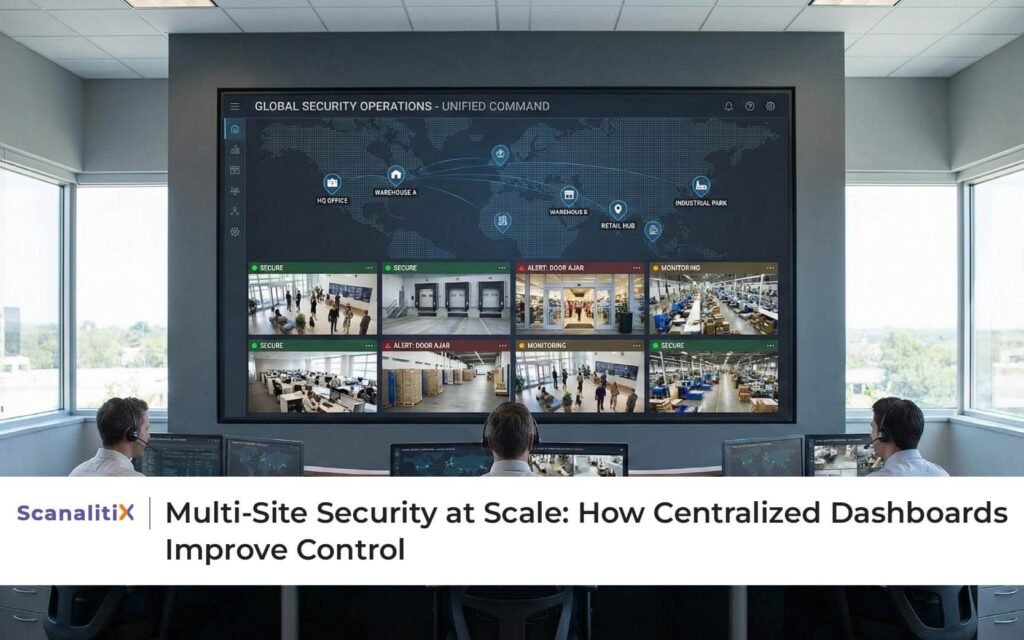
A centralized security dashboard acts as a command center. Instead of hopping between tools, teams gain a unified interface that aggregates:
- Events from multiple locations
- Alerts across systems
- Policy compliance status
- Performance and risk metrics
This approach transforms security from a site-by-site operation into a coordinated, enterprise-wide strategy.
From scattered alerts to a single pane of glass
One of the biggest advantages of centralized security monitoring is the shift from noise to clarity.
Traditional setups flood teams with alerts-most of them low priority or false positives. A single pane of glass security approach changes this by correlating events across sites and systems, helping teams understand context, not just triggers.
With centralized dashboards, organizations gain:
- Security visibility across sites in real time
- Unified views of incidents unfolding across locations
- Prioritized alerts instead of raw notifications
This level of visibility allows security teams to see patterns that would otherwise remain hidden—such as repeated anomalies across different sites or coordinated incidents targeting multiple facilities.
Speed matters: response time as a competitive advantage
In security, response time often determines impact.
When teams operate with fragmented tools, even identifying the root cause of an incident can take hours. Escalation paths are manual. Data must be pulled from different systems. Decisions are delayed.
Organisations that adopt centralized dashboards and SOC automation see a dramatic shift. Many report reducing incident containments time from hours to minutes by streamlining workflows and automating first-response actions.
This is where security incident response optimization becomes tangible-not theoretical. Faster containment means:
- Reduced operational disruption
- Lower financial and reputational damage
- More confident, proactive security teams
What centralized dashboards actually deliver
A modern SOC dashboard for enterprises is far more than a visual interface. It is an operational layer that enables scale.
Key capabilities include:
- Real-time security visibility across all sites
- Centralized alert management with intelligent prioritization
- Cross-site incident timelines
- Automated workflows for response and escalation
Unified reporting for audits and compliance
Combined with advanced security analytics and reporting, centralized dashboards help organizations move from reactive firefighting to predictive, risk-aware operations.
Detection improves when data is unified
Detection accuracy is one of the most underestimated benefits of centralization.
When data lives in silos, systems lack context. An event that seems harmless in isolation may be critical when viewed alongside activity from other locations.
After consolidating security data into centralized platforms, ~81% of organizations report improved threat detection. This improvement comes from correlation-linking behaviours, assets, and anomalies across sites rather than evaluating them in isolation.
For security teams, this means fewer blind spots and stronger confidence in decision-making.
Governance at scale: beyond monitoring
Centralized dashboards are not just operational tools—they are governance enablers.
For enterprises managing Multi-Tenant environments or complex portfolios of locations, dashboards enable:
- Consistent policy enforcement
- Standardized incident handling
- Unified reporting across tenants and sites
This is especially critical for organizations pursuing Multi Site Governance, where accountability, compliance, and audit readiness must be maintained without slowing operations.
Centralization ensures that security rules don’t vary by location and that leadership always has a clear view of enterprise-wide risk posture.
How Scanalitix strengthens centralized security control
This is where platforms like Scanalitix step in to operationalize centralized security at scale.
Scanalitix enables organizations to unify video, data, and intelligence into a single, intelligent layer that supports:
- Centralized security monitoring across locations
- AI-powered analytics for faster detection
- Real-time visibility across distributed environments
- Scalable security infrastructure designed for enterprise growth
By acting as a centralized intelligence layer, Scanalitix helps security teams shift from manual monitoring to insight-driven action—making enterprise-wide control both practical and scalable.
Building a scalable security infrastructure
As enterprises grow, security systems must grow with them-without adding complexity.
A scalable security infrastructure built around centralized dashboards allows organizations to:
- Add new sites without re-architecting systems
- Maintain consistent security posture across regions
- Adapt quickly to new threat vectors
Centralization doesn’t mean rigidity. Done right, it enables flexibility—letting teams scale operations while maintaining control.
Future outlook: the centralized, intelligent SOC
The future of enterprise security is not about more tools-it’s about smarter orchestration.
Centralized dashboards will continue evolving into intelligent command centers where AI assists analysts, automation handles routine responses, and leaders gain real-time insights into enterprise risk.
As threats become more coordinated and enterprises more distributed, Multi-site security management will depend on platforms that unify visibility, intelligence, and action-without slowing teams down.
In that future, centralized dashboards won’t be optional. They’ll be the foundation of secure, resilient, and scalable organizations.
.