
How Video AI Turns Footage into Actionable Intelligence?
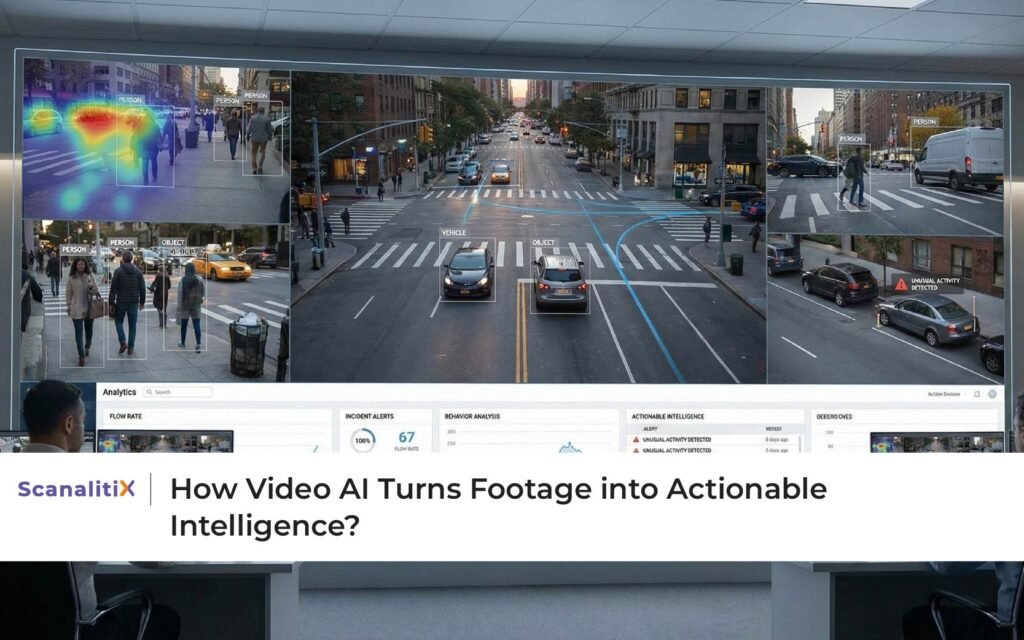
Table of Contents
For decades, video surveillance served one basic purpose: record what happened. Cameras captured footage, stored it, and helped investigators look back after an incident occurred. While this approach provided evidence, it offered little help in preventing problems or improving operations in real time.
Today, that model is rapidly becoming obsolete.
With the rise of Video AI, surveillance has evolved from passive recording into an active intelligence layer. Cameras no longer just watch. They analyze, interpret, and generate insights that decision-makers can act on instantly. This shift is transforming how cities, enterprises, and public infrastructure manage safety, efficiency, and risk.
The real value of Video AI lies in its ability to convert raw visual data into actionable intelligence. Intelligence that informs decisions, triggers timely responses, and improves outcomes across sectors.
From Raw Footage to Meaningful Data
A single camera can generate thousands of frames every minute. Across hundreds or thousands of cameras, the data volume becomes overwhelming. Human operators cannot realistically monitor, process, and interpret this scale of information consistently.
Video AI addresses this challenge by applying computer vision and machine learning to video streams. Instead of treating footage as static images, AI models analyze visual patterns frame by frame. They identify objects, track movement, recognize behaviors, and detect anomalies.
According to IBM, computer vision enables systems to “derive meaningful information from digital images, videos, and other visual inputs,” replicating and often surpassing human perception at scale. This capability is what allows Video AI to move beyond visibility and into understanding.
In practice, this means a system can differentiate between a person and a vehicle, identify unusual movement, detect overcrowding, or recognize when an object has been left unattended. These detections form the building blocks of actionable intelligence.
Context Is What Turns Detection into Intelligence
Detection alone is not enough. Intelligence emerges when systems understand context.
Traditional surveillance systems rely on rule-based triggers such as motion detection. These triggers often generate false alarms because they lack contextual awareness. A moving shadow, a stray animal, or routine activity can trigger alerts that waste time and attention.
Video AI adds context by learning what is normal in a given environment. It observes patterns over time and adapts to location-specific behavior. For example, a busy retail store during business hours looks very different from the same space late at night. Video AI understands these differences.
Research published by MarketsandMarkets highlights that AI-based video analytics significantly reduce false positives by learning environmental patterns and behavior trends. This contextual understanding ensures that alerts are relevant and meaningful.
When alerts are accurate, response becomes faster and more confident. That is the difference between raw detection and actionable intelligence.
Real-Time Insights Enable Faster Decisions
One of the most powerful advantages of Video AI is real-time insight.
In environments such as traffic intersections, railway platforms, warehouses, or public spaces, delays can escalate risk. Video AI processes live feeds and generates immediate alerts when predefined conditions are met.
For example, in traffic management, AI can detect congestion, accidents, or signal violations as they occur. In industrial environments, it can identify safety violations or equipment misuse instantly. In public areas, it can flag crowd build-ups or unusual movement patterns before they become dangerous.
The World Economic Forum notes that real-time video analytics play a critical role in improving situational awareness in smart cities and large public infrastructures. Faster insight leads directly to faster action, which often determines outcomes.
Turning Intelligence into Action Through Integration
Actionable intelligence is only valuable if it leads to action.
This is where integration becomes essential. Video AI must connect seamlessly with monitoring platforms, alerting systems, and operational workflows. When an AI system detects an issue, it should automatically notify the right team, assign responsibility, and track resolution.
For instance, if Video AI detects unauthorized access in a restricted zone, the alert should flow into a central monitoring system, escalate based on severity, and dispatch on-ground personnel. The incident should remain open until verified resolution.
According to research on intelligent operations, organizations that integrate analytics with operational workflows respond to incidents up to 60 percent faster than those that rely on manual processes.
Video AI becomes actionable when it is embedded into decision-making systems, not when it operates in isolation.
Beyond Security: Operational Intelligence from Video AI
While security is often the starting point, Video AI delivers value far beyond threat detection.
In retail, AI-driven video analytics provide insights into footfall patterns, dwell time, and queue behavior. These insights help optimize store layouts, staffing, and customer experience. McKinsey reports that retailers using advanced analytics can see significant improvements in sales productivity and operational efficiency.
In logistics and warehousing, Video AI identifies bottlenecks, unsafe practices, and inefficiencies in material movement. It supports loss prevention while also improving throughput and safety.
In corporate workplaces, AI-powered surveillance helps monitor access control compliance, detect hazards, and ensure employee safety. It also provides data that informs space utilization and facility management decisions.
In each case, the same video feeds serve multiple purposes. The intelligence extracted adapts to the business context.
Learning Over Time: How Video AI Improves Continuously
Another defining characteristic of Video AI is its ability to learn and improve.
Machine learning models refine their accuracy as they process more data. They adapt to seasonal changes, evolving behavior patterns, and new risk scenarios. Over time, the system becomes better at distinguishing between normal activity and genuine anomalies.
This continuous learning capability is particularly valuable in dynamic environments such as cities, transport networks, and large enterprises. According to research published by IEEE, adaptive video analytics systems outperform static rule-based systems in long-term accuracy and resilience.
As a result, Video AI does not remain static. It evolves alongside the environment it monitors.
Responsible Intelligence: Privacy and Governance
As Video AI becomes more powerful, responsible deployment becomes critical.
Actionable intelligence must be balanced with ethical considerations, privacy safeguards, and transparent governance. Modern Video AI systems increasingly focus on behavior-based analytics rather than personal identification. Data minimization, role-based access, and clear retention policies help ensure compliance with regulations and public expectations.
The European Commission and other global bodies emphasize that trustworthy AI requires transparency, accountability, and purpose limitation. Surveillance systems that adhere to these principles build trust while delivering value.
Responsible Video AI strengthens legitimacy and long-term adoption.
Why Platforms Matter More Than Point Solutions
Extracting actionable intelligence from video requires more than algorithms. It requires a platform that brings together video management, analytics, monitoring, and response.
Fragmented systems create friction. Alerts get lost. Insights fail to translate into action. Unified platforms ensure that intelligence flows smoothly from detection to decision.
This is where modern surveillance ecosystems distinguish themselves. They turn video into a continuous intelligence loop rather than isolated insights.
Where Scanalitix Fits In
Scanalitix approaches Video AI as an intelligence ecosystem rather than a standalone feature.
By combining video management, AI-powered analytics, centralized monitoring, and field response workflows, Scanalitix ensures that insights do not remain theoretical. Detection leads to action. Action leads to resolution. Resolution feeds learning.
The platform supports real-time analytics at the edge, centralized intelligence across locations, and structured response management. This allows organizations to deploy Video AI in ways that align with their operational realities.
Whether the goal is safer public spaces, more efficient operations, or faster incident response, Scanalitix enables Video AI to deliver on its promise quietly and effectively.
Conclusion
Video AI represents a fundamental shift in how organizations use visual data. It transforms footage from passive records into active intelligence. It shortens the distance between seeing and acting. It enables decisions that are faster, smarter, and more confident.
As environments grow more complex and expectations rise, the ability to turn video into actionable intelligence becomes a competitive and societal advantage. The future of surveillance is not about watching more. It is about understanding better.
And when intelligence is embedded into everyday operations, video stops being just a camera feed. It becomes a strategic asset.