
How AI Surveillance Strengthens Safety in Transport Infrastructure?
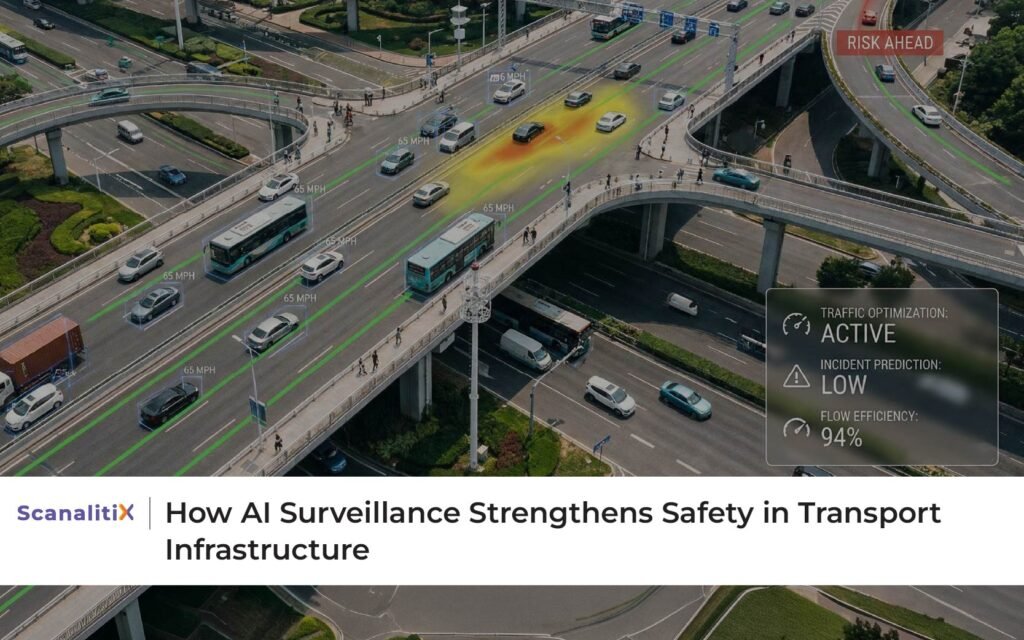
Table of Contents
Transport infrastructure is the circulatory system of modern economies. Highways connect cities, railways move millions daily, airports link nations, and metro networks keep urban centers functioning. Yet as transport systems expand and passenger volumes grow, safety becomes increasingly complex to manage.
Congestion, accidents, vandalism, unauthorized access, crowd surges, and infrastructure fatigue create constant risk. Traditional monitoring methods, built around passive CCTV and manual oversight, struggle to keep pace with the scale and speed of modern transport networks.
This is where AI-powered surveillance has emerged as a transformative force. By turning cameras into intelligent sensors and integrating analytics with command systems, AI surveillance strengthens safety across roads, railways, airports, ports, and public transit hubs.
The goal is not simply to record events, but to anticipate risks, respond faster, and operate transport ecosystems more efficiently.
The Growing Complexity of Transport Safety
Transport infrastructure operates at enormous scale. According to the World Bank, road traffic injuries alone account for approximately 1.19 million deaths globally each year. Urban congestion costs economies billions in lost productivity and fuel consumption. Meanwhile, airports and rail networks must manage both safety and security across high-density environments.
As cities expand, the pressure intensifies. The United Nations estimates that nearly 68 percent of the world’s population will live in urban areas by 2050. This growth places unprecedented demand on public transport systems and roadway networks.
In such environments, safety cannot rely solely on physical patrols or human observation. Operators need continuous, real-time visibility that can adapt to changing conditions. AI-powered surveillance provides this capability.
From Passive Cameras to Intelligent Monitoring
Traditional surveillance systems capture footage but require human operators to interpret it. Monitoring dozens or hundreds of screens simultaneously often leads to delayed response or missed incidents.
AI-powered surveillance changes the equation. Through computer vision and machine learning, cameras analyze video feeds in real time. Instead of simply detecting motion, AI identifies patterns, recognizes objects, tracks movement, and detects anomalies.
For example, at a busy highway intersection, AI can detect wrong-way driving, stalled vehicles, signal violations, or pedestrians entering restricted lanes. In railway stations, it can monitor platform crowd density and identify unusual behavior. In airports, it can flag unattended baggage or restricted-area breaches instantly.
According to MarketsandMarkets, the global video analytics market is experiencing rapid growth, driven largely by smart infrastructure and transport deployments. The report highlights that AI-based analytics significantly improve detection accuracy while reducing false alarms, making them well suited for large-scale transport environments.
Road Safety and Intelligent Traffic Management
One of the most visible applications of AI surveillance lies in road safety.
Urban congestion not only frustrates commuters but also increases accident risk. AI-enabled traffic surveillance systems analyze vehicle flow, measure congestion levels, and adapt signal timings dynamically. These systems also detect accidents in real time and notify emergency services immediately.
The World Bank reports that intelligent transport systems, including AI-based video analytics, can improve travel time efficiency and enhance road safety outcomes. By providing continuous data on traffic patterns, cities can make evidence-based infrastructure improvements.
In addition, AI surveillance helps enforce traffic regulations. Automated detection of red-light violations, speeding, and illegal lane changes improves compliance while reducing the need for manual enforcement.
The result is a safer and more efficient road network.
Enhancing Rail and Metro Safety
Railway and metro systems present unique safety challenges. High passenger density, platform-edge risks, and complex signaling systems require vigilant oversight.
AI-powered surveillance strengthens safety by monitoring platform crowd density and detecting potential fall incidents. It can identify when individuals cross restricted lines or enter tracks. It can also detect suspicious behavior in real time, enabling quicker intervention.
Research published by the International Association of Public Transport (UITP) emphasizes the importance of digital technologies, including AI analytics, in enhancing passenger safety and operational reliability across rail systems.
In metro networks, centralized command centers integrate AI-generated alerts with operational workflows. When incidents occur, staff receive precise location data, reducing response time significantly.
Airports and Critical Infrastructure Security
Airports represent some of the most complex transport environments in the world. Passenger screening, baggage handling, access control, and perimeter security must operate seamlessly.
AI surveillance supports these operations by monitoring terminal crowd flow, detecting abandoned objects, and identifying unauthorized access attempts. It enhances perimeter security by recognizing unusual movement patterns and intrusions.
The International Civil Aviation Organization (ICAO) highlights the growing role of advanced technologies in improving aviation security. AI-based surveillance systems provide a proactive layer of protection, complementing traditional screening measures.
Moreover, video analytics help airports optimize passenger flow. By analyzing queue lengths and congestion patterns, operators can adjust staffing and streamline processes, improving both safety and traveler experience.
Ports, Highways, and Freight Corridors
Transport infrastructure extends beyond passenger mobility. Ports, logistics hubs, and freight corridors are vital economic arteries.
AI-powered surveillance enhances safety in these environments by monitoring container yards, detecting unauthorized access, and tracking vehicle movement. It identifies congestion points, flags unsafe equipment usage, and helps prevent cargo theft.
According to the World Economic Forum, digital transformation in logistics and ports can improve operational efficiency while strengthening security. AI analytics provide the real-time visibility required to achieve these improvements.
When integrated into centralized monitoring systems, surveillance data enables authorities to coordinate across departments, ensuring swift and informed decision-making.
Faster Emergency Response Through Real-Time Intelligence
Perhaps the most significant advantage of AI surveillance in transport infrastructure is its impact on emergency response.
When an accident, fire, or security breach occurs, seconds matter. AI systems detect incidents instantly and trigger alerts within command centers. Integrated workflows ensure that police, fire, and medical teams receive precise information about location and severity.
Deloitte research on intelligent operations shows that organizations integrating analytics with operational response systems reduce incident response time dramatically compared to manual processes.
In transport networks where thousands of people move simultaneously, faster response can prevent escalation and save lives.
Balancing Safety with Privacy and Governance
Deploying AI surveillance across transport infrastructure must be accompanied by responsible governance. Public trust depends on transparency and ethical use.
Modern systems increasingly incorporate privacy-by-design principles, focusing on behavior detection rather than intrusive identification. Data minimization, role-based access control, and clear retention policies help ensure compliance with regulatory standards.
The European Commission’s guidelines on trustworthy AI emphasize transparency, accountability, and proportionality in surveillance deployments. Transport authorities that adopt these principles strengthen both safety and public confidence.
Where Scanalitix Fits In
Transport infrastructure demands intelligence that is immediate, scalable, and reliable.
Scanalitix enables this by deploying the flagship feature, ICCC – Integrated Command & Control Centers for supporting centralized oversight across networks, and seamless coordination with field teams.
By turning raw video feeds into actionable intelligence, Scanalitix helps transport operators anticipate risk, respond faster, and maintain operational continuity. The platform’s flexibility allows it to adapt to highways, railways, airports, ports, and urban transit systems alike.
Rather than overwhelming teams with data, it prioritizes meaningful alerts and ensures that every incident moves from detection to resolution efficiently.
In doing so, it quietly strengthens the safety backbone of modern transport infrastructure.
Conclusion
Transport systems keep economies moving and cities connected. As infrastructure grows more complex, safety challenges grow alongside it.
AI-powered surveillance offers a powerful solution by transforming cameras into intelligent systems capable of real-time analysis and rapid response. From roads and railways to airports and ports, AI strengthens safety while improving efficiency.
When combined with responsible governance and integrated workflows, AI surveillance becomes more than a monitoring tool. It becomes a strategic asset for resilient, future-ready transport networks.