
Future of E-Surveillance in India: AI, Automation & Smart Cities in 2026
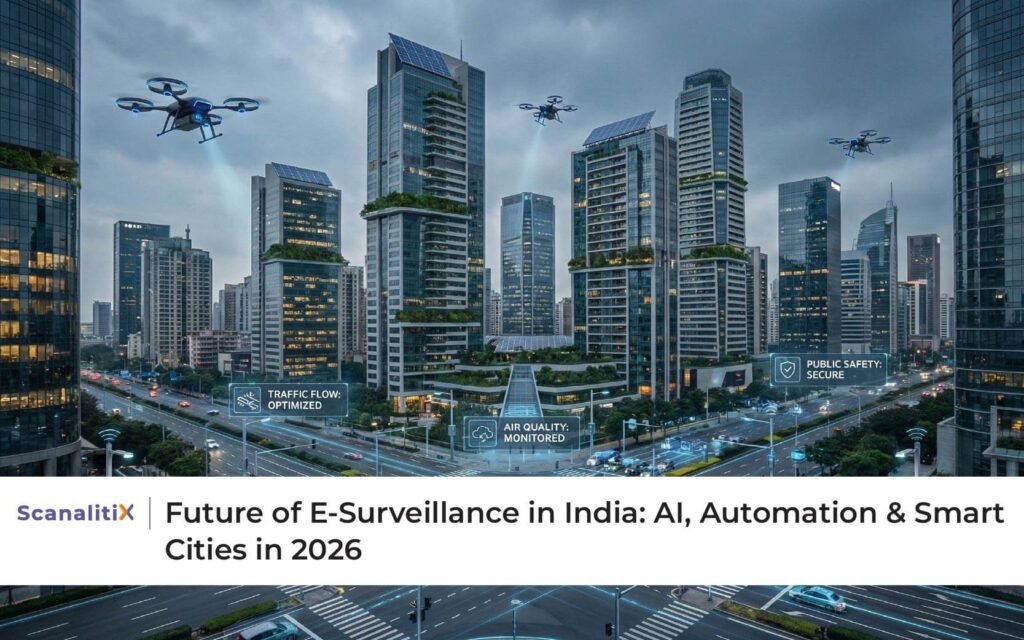
Table of Contents
Introduction: Are India’s Cities Becoming Intelligent Observers?
What if cities could not just see, but understand? What if surveillance systems could detect anomalies, predict risks, and enable faster decisions without constant human monitoring? This is no longer a futuristic scenario; it is the emerging reality of E-Surveillance in India, driven by AI, automation, and smart city infrastructure.
The scale of this transformation is reflected in the numbers. India’s video surveillance systems market is projected to grow from USD 7.5 billion in 2025 to USD 19.5 billion by 2034, reflecting massive nationwide adoption. This growth signals more than increased camera installations-it represents a shift toward intelligent, automated, and integrated surveillance ecosystems that form the backbone of modern urban infrastructure.
From highways and airports to manufacturing plants and smart city command centers, surveillance is evolving from passive observation to proactive intelligence. The future of surveillance technology in India will not depend on how many cameras are deployed, but on how intelligently they operate, analyze, and respond.
From Passive Monitoring to Intelligent Awareness
Traditional surveillance systems were built to record events. Their primary purpose was retrospective-reviewing footage after an incident had already occurred. Today, however, AI surveillance systems in India are fundamentally redefining this role.
AI-powered systems use intelligent video analytics in India to detect suspicious behavior, monitor crowd patterns, and identify anomalies in real time. Instead of requiring human operators to constantly monitor multiple screens, automated systems can analyze thousands of video feeds simultaneously and generate actionable alerts.
This evolution is particularly important for public safety surveillance in India, where rapid response can prevent escalation of threats. Whether it is detecting unauthorized access in restricted zones or identifying abandoned objects in public areas, AI enables surveillance systems to act as proactive security enablers.
The shift toward automation in video surveillance in India is also improving operational efficiency. Automated alerts, facial recognition, object tracking, and behavioral analytics reduce reliance on manual intervention while improving accuracy and response time.
This transformation answers a critical question: surveillance is no longer just about visibility-it is about intelligence.
The Rise of AI-Powered CCTV: Transforming Surveillance Capabilities
The rapid growth of AI-enabled surveillance reflects the increasing reliance on automation and analytics. India’s AI-powered CCTV market is expected to grow from USD 827 million in 2023 to USD 3.66 billion by 2030, at a CAGR of 21.79%. This expansion highlights how AI is becoming central to the next generation of surveillance infrastructure.
AI CCTV India solutions offer capabilities that were previously impossible with conventional systems. These include real-time facial recognition, vehicle identification, intrusion detection, and predictive monitoring. Such systems are increasingly being deployed across airports, metro stations, industrial facilities, and urban environments.
One of the key benefits of AI in surveillance systems is scalability. AI enables a single operator to monitor large networks efficiently, reducing operational overhead while improving coverage. This is particularly critical in densely populated cities, where monitoring needs are complex and constantly evolving.
Moreover, AI-driven surveillance supports faster decision-making. Automated alerts allow security personnel to respond immediately to incidents, reducing risk and improving public safety outcomes.
This growth is not merely technological; it represents a shift toward smarter, more adaptive surveillance ecosystems.
Smart Cities and the Emergence of Integrated Surveillance Ecosystems
India’s smart city initiatives are accelerating the deployment of intelligent surveillance infrastructure. At the heart of this transformation lies smart city surveillance in India, which integrates cameras, analytics, and centralized monitoring into unified systems.
The Delhi Safe City Project alone includes the deployment of 10,000 new AI-enabled cameras and the integration of 15,000 existing cameras into centralized command systems, highlighting the scale at which surveillance is being modernized. These deployments are connected to smart city command center surveillance platforms, also known as Integrated Command and Control Centers (ICCCs).
These centralized hubs serve as the operational core of urban security. They aggregate data from surveillance cameras, traffic systems, emergency services, and public infrastructure, enabling real-time situational awareness.
The role of AI in smart city surveillance is particularly significant. AI enables intelligent traffic monitoring, automated incident detection, and predictive analysis. For instance, AI can identify traffic congestion patterns and optimize signal timings or detect unusual activity in public areas and alert authorities instantly.
This integration enhances smart city security in India, ensuring faster emergency response, improved urban management, and enhanced citizen safety.
Smart cities are not just deploying surveillance-they are building intelligent ecosystems where data drives decision-making.
Automation: Redefining Surveillance Efficiency and Responsiveness
Automation is emerging as a defining feature of the future of AI surveillance in India by 2026. Automated surveillance systems can monitor environments continuously, detect anomalies, and generate alerts without human intervention.
This shift toward automated surveillance systems in India is transforming industries beyond public safety. Manufacturing facilities use automated surveillance to monitor operational safety. Transportation networks use automated monitoring to ensure efficiency and security. Commercial spaces use intelligent systems to manage access and prevent unauthorized entry.
Automation also improves scalability. Large infrastructure projects, such as airports or metro networks, require continuous monitoring across hundreds or thousands of cameras. Automation ensures that these systems remain efficient and responsive.
Another critical advantage of automation is consistency. Human operators may experience fatigue or oversight, but automated systems maintain continuous monitoring with consistent performance.
Automation is not replacing human oversight-it is augmenting it, enabling faster, more accurate, and more reliable surveillance operations.
Cloud Surveillance: Enabling Scalable and Connected Security
Cloud technology is playing a vital role in shaping E-Surveillance in India, enabling scalable and flexible surveillance architectures.
Cloud surveillance in India allows organizations to store, access, and analyze surveillance data remotely. Instead of relying on localized storage infrastructure, cloud-based systems provide centralized access and seamless scalability.
Cloud-enabled systems support real-time analytics, enabling faster decision-making. They also improve collaboration by allowing multiple stakeholders to access surveillance feeds securely.
The integration of cloud technology with AI enables advanced analytics, predictive monitoring, and intelligent alerting. This combination enhances operational efficiency and strengthens security outcomes.
Cloud-based surveillance is particularly valuable for smart cities, where large volumes of data must be managed efficiently.
Intelligent Video Analytics: Enhancing Public Safety and Operational Efficiency
The increasing adoption of AI video analytics in public safety is transforming how surveillance systems operate. AI-powered analytics can identify patterns, detect anomalies, and provide actionable insights in real time.
This capability is especially valuable in urban environments, where surveillance systems must monitor complex and dynamic scenarios.
For example, intelligent analytics can detect unusual crowd behavior, unauthorized access, or potential security threats. This enables faster response and enhances overall security effectiveness.
In addition to public safety, intelligent analytics supports infrastructure management. Surveillance systems can monitor traffic flow, identify bottlenecks, and improve operational efficiency.
The ability to extract actionable insights from surveillance data is redefining how surveillance systems contribute to urban management and security.
How AI Is Transforming Surveillance in India’s Urban and Industrial Landscape
The transformation of surveillance is not limited to public infrastructure. Industries across sectors are adopting intelligent surveillance solutions.
Manufacturing facilities use AI surveillance to ensure operational safety and monitor production processes. Transportation systems use AI to monitor traffic and enhance security. Commercial buildings use intelligent surveillance to manage access and prevent unauthorized entry.
This widespread adoption reflects how AI is transforming surveillance in India, enabling organizations to enhance security while improving operational efficiency.
AI-powered surveillance is becoming an essential component of modern infrastructure, supporting safety, efficiency, and resilience.
The Future Outlook: Intelligent, Automated, and Integrated Surveillance
The future of E-Surveillance in India will be defined by intelligence, automation, and integration. Surveillance systems will continue evolving from passive monitoring tools into proactive security platforms.
AI, automation, and cloud technologies will enable surveillance systems to analyze data, predict risks, and enable faster response. Smart city initiatives will continue driving adoption, integrating surveillance into broader urban infrastructure.
The future of surveillance technology in India lies in intelligent systems that enhance security while improving operational efficiency.
As cities become smarter and infrastructure becomes more connected, surveillance will play an increasingly critical role in ensuring safety and resilience.
The question is no longer whether surveillance will evolve, but how intelligently it will shape the cities of tomorrow.