
Edge AI vs Cloud AI in Video Surveillance: What Works Where and Why
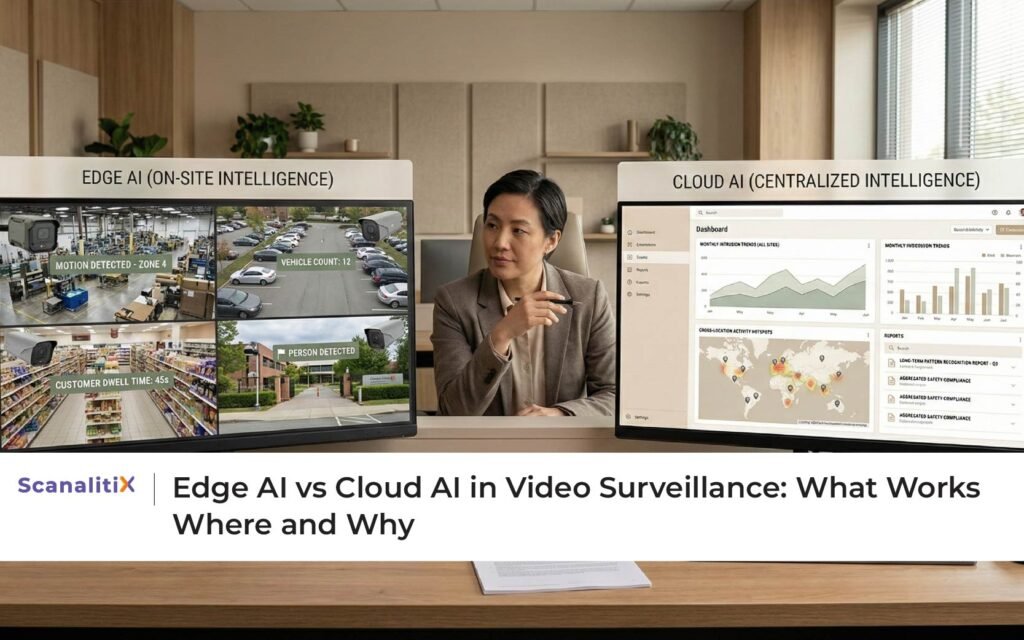
Table of Contents
Video surveillance has evolved far beyond passive recording. Today, cameras generate intelligence. They detect patterns, identify anomalies, and trigger real-time responses. At the heart of this transformation lies artificial intelligence, deployed in two primary ways: Edge AI and Cloud AI.
Both approaches promise smarter surveillance. However, they solve different problems, serve different environments, and come with distinct trade-offs. Choosing between edge and cloud AI is not about which is superior in absolute terms. It is about understanding where each works best and why.
As cities, enterprises, and public infrastructure invest heavily in AI-powered surveillance, this distinction becomes critical. The right architecture can determine response speed, cost efficiency, data privacy, and overall system reliability.
Understanding the Two Models
To appreciate the difference, it helps to start with a simple distinction.
Edge AI processes video data directly at or near the camera. The analytics run on edge devices such as smart cameras, on-premise servers, or local gateways. Video does not need to travel far before decisions are made.
Cloud AI, on the other hand, sends video streams or extracted metadata to centralized cloud infrastructure. Powerful cloud servers process the data, apply advanced analytics, and send insights back to operators or systems.
Both models aim to extract meaning from video, but they do so in fundamentally different ways.
Why Edge AI Matters: Speed, Reliability, and Privacy
One of the strongest advantages of edge AI is latency reduction. When analytics happen close to the source, decisions occur in milliseconds. This matters in environments where immediate response is essential.
Consider scenarios such as traffic intersections, factory floors, railway platforms, or ATM kiosks. In these environments, delays of even a few seconds can mean accidents, security breaches, or operational disruption. Edge AI allows cameras to detect incidents such as wrong-way driving, intrusion, or safety violations and trigger alerts instantly.
Another key benefit is reliability. Edge AI continues to function even when network connectivity is unstable or unavailable. Remote sites, border areas, highways, rural ATMs, and temporary installations often face connectivity constraints. In such cases, relying entirely on cloud processing creates risk. Edge AI ensures that surveillance does not stop when the network does.
Privacy is also a major consideration. Many regulations and public expectations require minimizing the movement of raw video data, especially in sensitive environments such as workplaces, healthcare facilities, or public spaces. By processing video locally and transmitting only alerts or anonymized metadata, edge AI significantly reduces privacy exposure.
Research from Gartner highlights that edge computing adoption is accelerating precisely because organizations want faster response and better control over sensitive data. The firm predicts that by 2025, a significant portion of enterprise data will be processed outside centralized data centers.
Where Cloud AI Excels: Scale, Depth, and Learning
While edge AI shines in immediacy, cloud AI offers scale and analytical depth.
Cloud infrastructure provides virtually unlimited computing power. This enables complex analytics that require large datasets, historical comparisons, and continuous model training. Use cases such as long-term behavior analysis, cross-location pattern detection, and city-wide insights benefit greatly from cloud AI.
For example, a smart city command center may want to analyze traffic trends across hundreds of intersections, identify recurring congestion patterns, or predict future risk zones. Similarly, a retail chain may want to compare footfall and dwell-time data across hundreds of stores to optimize layouts and staffing. These insights emerge only when data from many sources is aggregated and analyzed centrally.
Cloud AI also simplifies model updates and innovation. New analytics, improved algorithms, and enhanced detection capabilities can be rolled out centrally without touching individual devices. This makes cloud-based systems easier to evolve over time.
According to a McKinsey study on AI at scale, organizations that centralize advanced analytics in the cloud achieve faster innovation cycles and better enterprise-wide intelligence, especially when dealing with large, distributed operations.
The Cost and Bandwidth Equation
Cost is often misunderstood in the edge vs cloud debate.
At first glance, cloud AI appears cheaper because it avoids heavy on-premise hardware investments. However, video data is bandwidth-intensive. Streaming high-resolution video continuously to the cloud can quickly become expensive and inefficient, particularly in large deployments.
Edge AI reduces bandwidth usage by processing video locally and sending only relevant events or metadata to the cloud. This approach lowers recurring data transfer costs and improves system efficiency.
On the other hand, cloud AI reduces the need for powerful edge devices at every location. Organizations can deploy simpler cameras and rely on centralized processing. This can be cost-effective in environments with reliable connectivity and lower real-time sensitivity.
A report by MarketsandMarkets notes that hybrid architectures, which balance edge processing with cloud analytics, are increasingly favored because they optimize both cost and performance.
Use Case Fit: Matching Architecture to Environment
The most effective surveillance systems align architecture with operational needs.
Edge AI is particularly well suited for:
- Traffic management and road safety systems
- Industrial safety monitoring
- ATM and kiosk surveillance
- Remote or low-connectivity locations
- High-risk zones requiring instant alerts
Cloud AI works best for:
- City-wide analytics and planning
- Multi-branch enterprise surveillance
- Long-term trend analysis
- Training and improving AI models
- Cross-location correlation and reporting
Public infrastructure often benefits from edge AI for immediate detection and cloud AI for strategic oversight. Enterprises similarly rely on edge intelligence for on-site safety and cloud analytics for operational intelligence.
This explains why many leading smart city and enterprise deployments adopt hybrid AI architectures rather than choosing one model exclusively.
The Rise of Hybrid Surveillance Architectures
Increasingly, organizations recognize that the real power lies in combining edge and cloud AI.
In a hybrid model, edge devices handle time-critical analytics such as intrusion detection, crowd density alerts, or safety violations. Meanwhile, the cloud aggregates data across locations, performs deeper analysis, and supports reporting, governance, and continuous improvement.
The World Economic Forum emphasizes that hybrid architectures enable resilience and scalability, allowing systems to function locally while contributing to broader intelligence networks.
This approach also aligns well with responsible surveillance practices. Sensitive video can remain local, while anonymized insights support centralized decision-making.
Challenges and Governance Considerations
Despite the benefits, both edge and cloud AI present challenges that must be managed carefully.
Edge AI requires careful device management, firmware updates, and hardware lifecycle planning. Cloud AI raises concerns around data sovereignty, latency, and dependency on connectivity.
Governance, transparency, and ethical AI practices become critical. Organizations must clearly define what data is processed where, who has access, and how long data is retained. Successful deployments balance technological capability with trust and accountability.
Where Scanalitix Fits In
As surveillance environments grow more complex, rigid architectures no longer work. What organizations need is flexibility.
Scanalitix is built around the idea that surveillance intelligence should adapt to the environment, not the other way around. The platform supports edge-based analytics where speed and reliability matter most, while also enabling centralized monitoring and cloud-driven intelligence where scale and coordination are required.
By unifying video management, AI analytics, central monitoring, and field response workflows, Scanalitix allows organizations to deploy the right mix of edge and cloud capabilities without fragmentation. Edge devices handle real-time detection. Central systems provide oversight, analytics, and governance.
This hybrid-first approach ensures that cities, enterprises, and public infrastructure can respond instantly on the ground while learning and improving at scale.
Conclusion
The debate between edge AI and cloud AI in video surveillance is not about choosing sides. It is about understanding context.
Edge AI delivers speed, resilience, and privacy. Cloud AI offers scale, intelligence, and adaptability. The future of surveillance lies in combining both, creating systems that are responsive in the moment and intelligent over time.
As safety, efficiency, and trust become non-negotiable, organizations must invest in architectures that reflect real-world complexity. Hybrid surveillance models, supported by platforms designed for flexibility, will define the next generation of smart surveillance.
In that future, intelligence will not live in one place. It will move seamlessly between edge and cloud, wherever it is needed most.