
E-Surveillance in Public Spaces: Balancing Safety, Privacy, and Trust
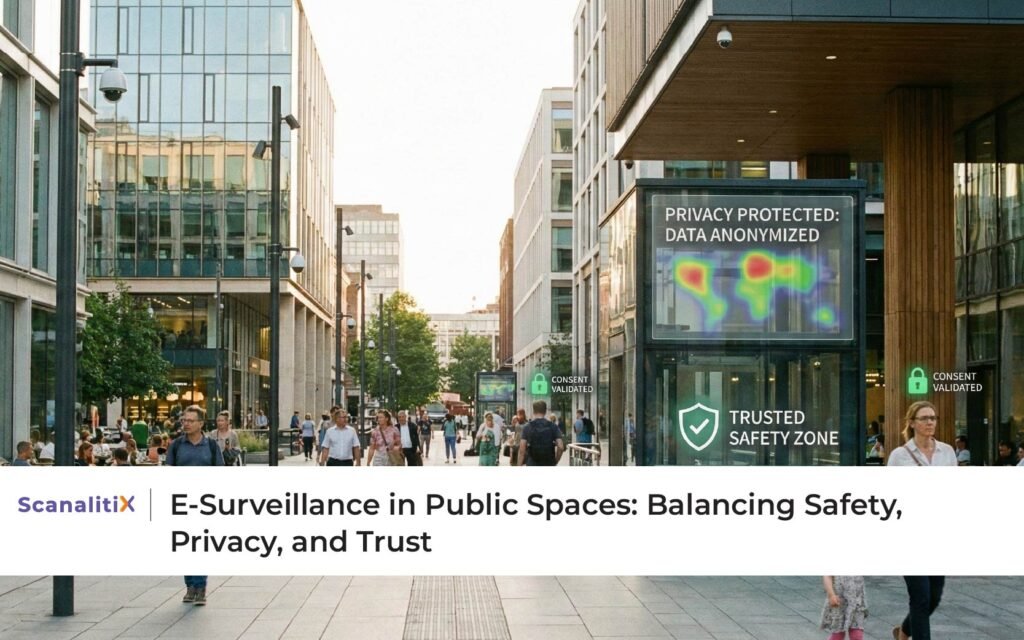
Table of Contents
Public spaces are the heartbeat of modern cities. Streets, transport hubs, parks, markets, stadiums, and civic centers bring people together and enable economic and social activity. At the same time, these shared environments face increasing challenges. Rising urban populations, large public gatherings, evolving security threats, and expectations of rapid emergency response make safety in public spaces more complex than ever.
To address these challenges, cities and authorities across the world have turned to e-surveillance. Cameras, sensors, and analytics now form a critical layer of urban safety infrastructure. However, surveillance in public spaces comes with a fundamental responsibility. It must protect people without compromising their privacy or eroding public trust.
The real challenge, therefore, is not whether to deploy e-surveillance, but how to deploy it responsibly.
Why Public Spaces Need E-Surveillance
Public spaces are open by design. Anyone can enter, move freely, and interact. This openness is what makes them vibrant, but it also creates vulnerabilities. Authorities must manage crowd safety, prevent crime, respond to emergencies, and maintain order across large and often unpredictable environments.
According to the United Nations, more than 55% of the world’s population currently lives in urban areas, a number expected to rise to nearly 68% by 2050. As cities grow denser, the complexity of managing public safety increases proportionally.
Traditional policing and manual monitoring alone cannot scale to this level of complexity. E-surveillance provides continuous visibility across large areas, helping authorities detect incidents early, coordinate responses, and improve overall situational awareness.
Studies by the World Economic Forum highlight that smart surveillance systems significantly improve response times and help cities manage safety proactively rather than reactively. In this sense, e-surveillance has become a foundational element of modern public safety networks.
From Passive Watching to Intelligent Monitoring
Early public surveillance systems focused on recording footage for post-incident review. Cameras captured events, but interpretation depended entirely on human operators. This approach had clear limitations. Human attention is finite, and monitoring dozens of screens simultaneously often leads to missed incidents.
Modern e-surveillance systems address this gap through AI-powered video analytics. Instead of simply recording, these systems analyze video in real time. They detect unusual movement patterns, crowd build-ups, unattended objects, traffic violations, or restricted-area breaches.
According to MarketsandMarkets, AI-based video analytics significantly reduces false alarms by adding context and pattern recognition to surveillance. This allows authorities to focus on meaningful alerts rather than noise.
Importantly, this shift transforms surveillance from a reactive tool into a preventive one. Authorities can intervene early, often before a situation escalates into a serious incident.
Safety Benefits Across Public Environments
E-surveillance supports safety in public spaces in multiple ways.
In transport hubs such as railway stations, airports, and metro systems, video analytics helps monitor crowd density, identify suspicious behavior, and manage passenger flow. During peak hours or disruptions, this visibility becomes critical for preventing accidents and panic.
On roads and intersections, intelligent surveillance detects traffic violations, accidents, and congestion in real time. The World Bank reports that intelligent transport systems, including AI-driven surveillance, can reduce travel time and significantly improve road safety.
In public events and large gatherings, crowd analytics enables authorities to track density and movement patterns. This helps prevent stampedes and ensures faster emergency response when needed.
Across parks, markets, and civic spaces, surveillance deters crime and provides reassurance to citizens. When used correctly, it enhances the feeling of safety rather than creating an atmosphere of control.
The Privacy Question: A Legitimate Concern
While the safety benefits of e-surveillance are clear, public acceptance depends heavily on how privacy is handled.
Citizens increasingly question how surveillance data is collected, stored, and used. Concerns include constant monitoring, misuse of footage, lack of transparency, and the potential for profiling or discrimination.
Regulatory frameworks around the world reflect these concerns. The European Union’s General Data Protection Regulation (GDPR) emphasizes data minimization, purpose limitation, and transparency. Similar principles appear in privacy guidelines issued by governments and international bodies.
Research by the European Commission on trustworthy AI stresses that surveillance technologies must respect fundamental rights and avoid unnecessary intrusion. This means surveillance should focus on behavior and safety, not identity or personal profiling unless legally justified.
Modern e-surveillance systems increasingly adopt privacy-by-design principles. These include masking or anonymizing faces, limiting data retention, role-based access controls, and strict governance policies.
Privacy protection is not a barrier to effective surveillance. It is a prerequisite for public trust.
Trust as the Cornerstone of Public Surveillance
Trust determines whether e-surveillance succeeds or fails in public spaces.
When citizens believe surveillance exists solely to protect them and operates transparently, acceptance increases. When systems appear opaque or excessive, resistance grows.
Trust is built through clear communication. Authorities must explain why surveillance exists, what it monitors, and how data is protected. Visible signage, public policies, and accountability mechanisms all play a role.
The International Association of Chiefs of Police notes that community trust improves when surveillance initiatives are accompanied by clear governance, oversight, and measurable public safety outcomes.
In practice, this means e-surveillance should be designed as a public service, not a covert control mechanism.
Centralized Command and Responsible Governance
Effective e-surveillance in public spaces requires more than cameras and analytics. It demands structured governance and coordination.
Many cities now operate Integrated Command and Control Centers (ICCCs) or similar hubs. These centers consolidate video feeds, sensor data, and alerts into a single operational view. AI helps prioritize incidents, while human decision-makers retain control.
India’s Smart Cities Mission highlights ICCCs as critical infrastructure for urban safety and service delivery. When combined with responsible data governance, these centers enable faster response without compromising oversight.
Centralization also supports accountability. Every alert, action, and resolution can be logged, audited, and reviewed. This transparency strengthens trust and compliance.
Balancing Act: Safety, Privacy, and Efficiency
The future of e-surveillance lies in balance.
Safety requires visibility and rapid response. Privacy requires restraint and safeguards. Trust requires transparency and accountability. Achieving all three demands thoughtful design, not one-size-fits-all deployment.
Research from McKinsey on smart cities suggests that data-driven urban management can improve quality-of-life indicators by 10-30% when implemented responsibly. Surveillance plays a key role in this improvement when aligned with ethical principles.
Public spaces thrive when people feel both safe and respected. Surveillance should support that experience, not undermine it.
Where Scanalitix Fits In
Scanalitix approaches e-surveillance in public spaces as an intelligence and governance challenge, not just a technology problem.
By integrating video management, AI-powered analytics, centralized monitoring, and structured response workflows, Scanalitix enables authorities to detect risks early and respond efficiently while maintaining oversight.
The platform emphasizes contextual analytics rather than indiscriminate monitoring. It supports role-based access, audit trails, and flexible deployment models that align with privacy and regulatory requirements.
Most importantly, Scanalitix allows surveillance systems to adapt to the environment they serve. Public safety teams gain real-time intelligence, decision-makers gain visibility, and citizens benefit from safer spaces without unnecessary intrusion.
In this way, Scanalitix quietly supports the balance that modern public surveillance demands.
Conclusion
E-surveillance in public spaces is no longer optional. As cities grow and public environments become more complex, intelligent monitoring plays a vital role in protecting people and infrastructure.
However, surveillance succeeds only when it balances safety with privacy and earns public trust. Technology alone cannot achieve this balance. Thoughtful design, clear governance, and responsible use are essential.
When implemented correctly, e-surveillance enhances public life. It enables safer streets, smoother transport, better emergency response, and more resilient cities. Platforms that respect context and ethics, while delivering actionable intelligence, will define the future of public safety.
The goal is not to watch more, but to protect better.