
Crowd Monitoring in the Age of Digital India
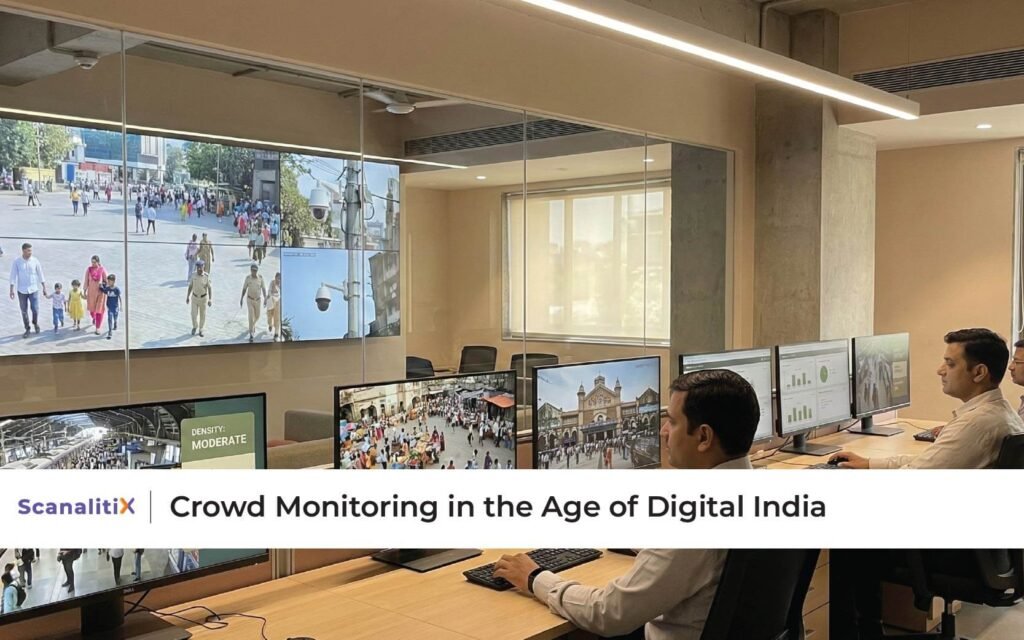
Table of Contents
Are We Ready to Manage Millions Safely in a Nation That Never Stops Moving?
How do you keep millions of people safe in spaces designed for thousands?
This is no longer a hypothetical question. In a country where festivals, elections, pilgrimages, and parades regularly draw crowds larger than the population of entire nations, crowd management has become one of the most complex public safety challenges of our time.
India’s answer is no longer barricades and whistles. It is intelligence.
Today, AI crowd monitoring in India is quietly reshaping how authorities anticipate risk, manage movement, and prevent disasters before they unfold. But are we truly ready for what lies ahead?
From Crowd Control to Crowd Intelligence
For decades, crowd control depended on experience, physical presence, and reactive response. It worked-until scale broke the system.
Consider the magnitude of modern gatherings. The 2025 Maha Kumbh Mela is expected to host over 400 million visitors, making it the largest human gathering on the planet. To manage this scale, authorities deployed more than 2,760 AI-enabled cameras across the site to detect surges and prevent overcrowding in real time.
This is not crowd control.
This is crowd monitoring in Digital India, where visibility becomes the first layer of safety.
Yet, visibility alone is not enough. Without intelligence, cameras only record history. With intelligence, they shape outcomes.
Why AI-Based Crowd Management Became Essential
The shift towards AI-based crowd management has been driven by a simple reality: human supervision cannot scale at the speed of modern crowds.
During the Ganeshotsav festival in Pune, police deployed over 400 AI-enabled CCTV cameras integrated with analytics. In just three days, the system generated more than 1,000 alerts related to overcrowding, abnormal movement, and suspicious objects.
This is the real promise of real-time crowd analytics.
Instead of asking, “What went wrong?”
Authorities now ask, “What is about to go wrong?”
Pilgrimage Management: Where Scale Meets Precision
Nowhere is this transformation more visible than in pilgrimage management.
At Tirumala, India’s first AI-powered Integrated Command & Control Centre operates with over 6,000 AI cameras. These systems continuously monitor queue lengths, density levels, and movement patterns, helping manage millions of pilgrims safely every year.
During the Kanwar Yatra, 29,000 CCTV cameras and 400 drones are deployed along pilgrimage routes to ensure continuous visibility and rapid response across hundreds of kilometres.
Here, crowd monitoring systems are no longer local tools.
They are national infrastructure.
Republic Day and the New Standard of Public Safety
The Republic Day parade in Delhi offers a telling example of how crowd monitoring for public events has evolved.
For the 77th Republic Day celebrations, more than 30,000 security personnel were deployed, supported by around 3,000 CCTV cameras along Kartavya Path and surrounding areas.
This hybrid model-human presence combined with machine intelligence-has become the backbone of public safety surveillance in India.
How Real-Time Crowd Analytics Changes Decision-Making
At the heart of modern deployments lies a quiet revolution in analytics.
Platforms built on video analytics for crowd control no longer just detect movement. They interpret behaviour.
With AI-Powered Video Analytics, systems can:
- Classify crowd density by risk levels
- Identify abnormal motion patterns
- Trigger automated escalation protocols
- Visualise heatmaps for rapid redeployment
This is where AI surveillance for mass gatherings moves from monitoring to decision support.
Managing Large Crowds with AI in Smart Cities
As cities evolve, smart city crowd monitoring is becoming part of everyday governance.
Railway stations, metro networks, airports, stadiums, markets, and intersections are now part of a continuous safety grid. In these environments, crowd monitoring in Digital India extends beyond festivals into daily life.
This integration supports:
- Faster emergency response
- Better traffic coordination
- Smarter urban planning
- Safer public spaces
This is how Digital India public safety initiatives are being operationalised on the ground.
The Operational Challenges That Still Remain
Despite rapid progress, challenges persist.
Many systems still face:
- Fragmented data across agencies
- Alert fatigue due to poor prioritisation
- Limited predictive capability
- Slow human-machine coordination
- Installing cameras is easy.
Building crowd safety technology in India that actually prevents incidents is much harder.
How Scanalitix Is Making Crowd Monitoring Smarter
This is where Scanalitix plays a critical role in strengthening AI crowd monitoring in India.
Scanalitix focuses on turning surveillance into decision intelligence.
Its platforms help authorities:
- Integrate multi-camera feeds into unified dashboards
- Prioritise alerts based on actual risk
- Visualise crowd density trends in real time
- Detect anomalies early through predictive modelling
- Support faster, data-driven on-ground action
By combining real-time crowd analytics with intelligent visualisation, Scanalitix strengthens the operational core of crowd safety technology in India.
The goal is simple:
Not more data.
But better decisions.
Ethics, Trust, and the Governance Question
As public safety surveillance in India expands, governance becomes as important as technology.
Key questions must be addressed:
- How is citizen privacy protected?
- How long is data retained?
- How are algorithms audited?
- How is misuse prevented?
For AI-based crowd management to remain trusted, transparency must evolve alongside capability.
The Future Outlook: From Monitoring to Prediction
The future of AI crowd monitoring in India lies in prediction, not observation.
Next-generation systems will integrate:
- Weather data
- Transport data
- Event schedules
- Historical crowd behaviour
This will allow authorities to anticipate risk before crowds arrive.
Instead of reacting to incidents, systems will prevent them.
This is the next frontier of how AI helps in crowd management.
Are We Watching Crowds or Understanding Them?
India will continue to host the world’s largest gatherings.
Crowds will grow.
Complexity will rise.
Expectations of safety will increase.
The real question is no longer about installing more cameras.
It is this:
Are we building systems that merely watch crowds
or systems that truly understand them?
Because in the age of Digital India,
seeing will not be enough.
Only intelligent action will define the future of public safety.