
Automated Incident Response: Can AI Press the Panic Button Faster Than Security Teams?
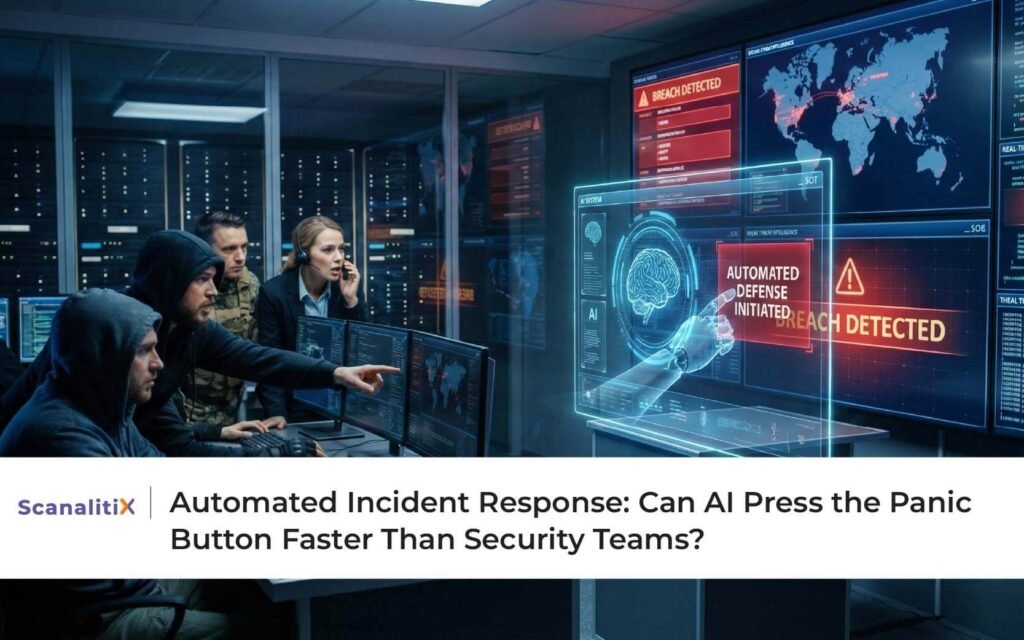
Table of Contents
What if the alarm didn’t wait for you?
Picture this.
A suspicious pattern appears in your system logs. It’s subtle- barely noticeable. A human analyst might catch it… eventually. But what if the system didn’t wait? What if it reacted instantly, flagged the anomaly, triggered containment, and neutralized the threat before anyone even reached for the keyboard?
That’s the question modern enterprises are being forced to ask: Can Automated Incident Response act faster than human security teams-and should it?
In a world where threats move at machine speed, hesitation isn’t just risky. It’s expensive.
The Speed Problem No One Talks About
Security teams aren’t slow because they’re inefficient. They’re slow because today’s threat landscape is brutally complex.
Alerts flood in from endpoints, networks, applications, and cloud workloads. Analysts must verify signals, rule out false positives, escalate issues, and coordinate responses-often under intense pressure. This human-dependent chain creates delay, and delay is exactly what attackers exploit.
Meanwhile, cybercrime is accelerating at a scale that’s hard to ignore. By 2027, cybercrime is projected to cost the global economy more than USD 23 trillion, turning security failures into boardroom-level risks.
This is where Automated Incident Response steps in-not as a replacement for humans, but as a force multiplier.
What Is Automated Incident Response, Really?
At its core, Automated Incident Response is the ability of security systems to detect, analyze, and respond to threats automatically—without waiting for manual intervention.
Instead of:
- Alert → Review → Decide → Act
The flow becomes:
- Detect → Decide → Act
Powered by AI, machine learning, and increasingly large language models (LLMs), Automated Incident Response enables systems to recognize patterns, understand context, and execute predefined or adaptive actions in real time.
This shift marks a critical leap in digital innovation from reactive defense to proactive resilience.
Why Manual Response Can’t Keep Up
Security Operations Centers (SOCs) are under unprecedented strain. According to the Osterman Research Report, nearly 90% of SOCs are overwhelmed by alert backlogs and false positives, and more than 80% of analysts report feeling constantly behind.
This isn’t a talent issue. It’s a scalability issue.
Humans excel at judgment, strategy, and complex reasoning. But they struggle when faced with:
- Thousands of alerts per day
- Repetitive triage decisions
- Time-sensitive containment actions
Automated Incident Response absorbs this operational burden—handling the noise so humans can focus on what actually matters.
How AI Decides Faster Than Humans
Modern Automated Incident Response systems don’t just look for known signatures. They analyze behavior, context, and deviations from normal patterns.
Organizations implementing LLM-based security monitoring have reported 61% faster threat identification compared to traditional signature-based approaches, reducing mean time to detection from 212 hours to 82 hours for sophisticated attacks.
That difference isn’t incremental—it’s transformational.
By correlating signals across systems and learning continuously, AI-driven Automated Incident Response can:
- Detect threats earlier in the kill chain
- Reduce dwell time dramatically
- Trigger immediate containment actions
Speed, in this context, becomes a security control.
Smarter Alerts, Not Louder Ones
One of the biggest misconceptions is that automation creates more alerts. In reality, Automated Incident Response does the opposite.
By filtering, prioritizing, and contextualizing signals, automation reduces alert fatigue. Instead of flooding analysts with raw data, systems surface only high-confidence incidents-already enriched with context and recommended actions.
This shift from volume to value is essential to sustainable security operations and long-term digital innovation.
Automated Workflows That Prevent Escalation
The real power of Automated Incident Response lies in execution.
Once a threat is confirmed, automated workflows can:
- Isolate affected endpoints
- Revoke compromised credentials
- Block malicious IPs or domains
- Trigger forensic data capture
- Notify stakeholders instantly
All of this can happen in seconds-not hours.
By acting early, Automated Incident Response prevents minor incidents from cascading into full-scale breaches, outages, or reputational damage.
Where Humans Still Matter-and Always Will
Automation isn’t about removing people from security. It’s about using them where they add the most value.
Humans remain essential for:
- Investigating complex incidents
- Making strategic risk decisions
- Refining response playbooks
- Governing ethical and compliance boundaries
Automated Incident Response handles speed and scale. Humans handle judgment and accountability. Together, they form a resilient security posture.
How Scanalitix Enables Smarter Automated Incident Response
Scanalitix plays a critical role in operationalizing Automated Incident Response through intelligent analytics and real-time decision frameworks.
By leveraging advanced data correlation, AI-driven insights, and contextual intelligence, Scanalitix helps organizations:
- Detect anomalies as they emerge, not after damage occurs
- Convert raw signals into actionable intelligence
- Orchestrate automated workflows that respond instantly
- Maintain visibility across complex, distributed environments
In the broader landscape of digital innovation, Scanalitix enables enterprises to move from reactive monitoring to proactive, intelligence-led security—where Automated Incident Response becomes a strategic capability, not just a technical feature.
The Bigger Question: Can You Afford to Wait?
The real question isn’t whether AI can press the panic button faster than security teams. It’s whether organizations can afford systems that hesitate.
As threats grow faster, smarter, and more automated, security responses must evolve in parallel. Automated Incident Response is no longer a futuristic concept-it’s a foundational requirement for modern security and digital innovation.
In a high-stakes environment, the fastest response often determines the outcome. And increasingly, that speed belongs to machines-guided, governed, and strengthened by human intelligence.