
Alerts to Action: How Real-Time Incident Monitoring Rewrites Security Playbooks
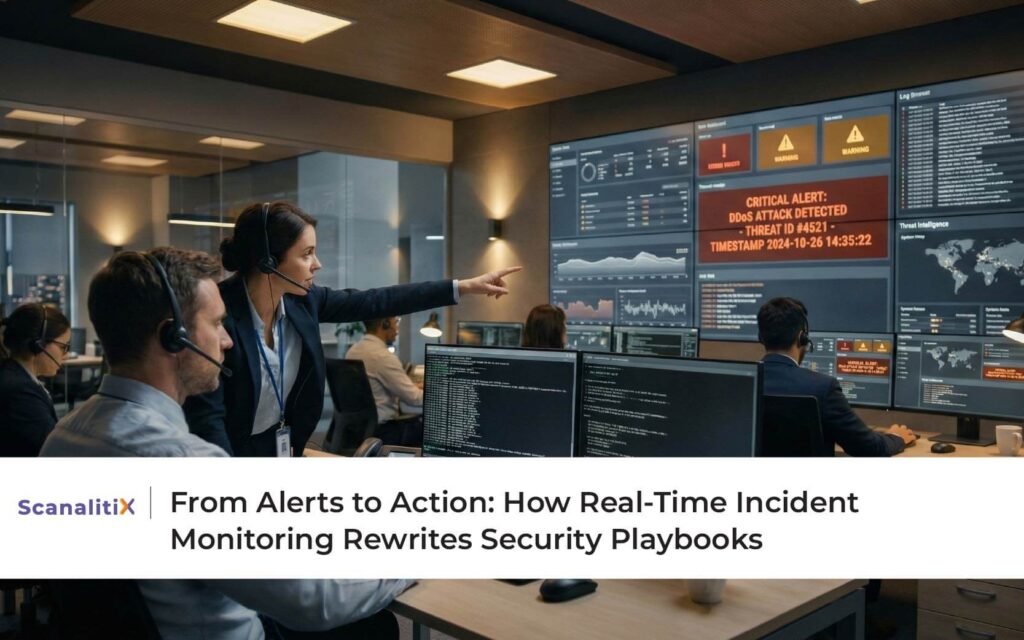
What happens after an alert fires?
Is it logged… queued… escalated… or quietly ignored in the noise?
For years, enterprises believed visibility equaled safety. If systems were monitored, logs were collected, and dashboards were full, security felt “under control.” But modern threats don’t wait for weekly reviews or post-incident reports. They unfold in minutes—sometimes seconds—forcing a hard truth into the open: monitoring alone is no longer enough.
Today’s enterprises must detect, analyze, and respond as incidents happen, not after the damage is done. That shift is rewriting security playbooks everywhere, and it starts with Real-Time Incident Monitoring.
Why Traditional Monitoring Breaks Down Under Pressure
Legacy monitoring tools were built for observation, not action. They generate alerts, but leave humans to interpret, correlate, and respond—often across fragmented systems.
This delay is no longer acceptable. According to industry data, 67% of organizations track Mean Time To Respond (MTTR) and 52% monitor Mean Time To Detect (MTTD), showing that speed has become a core security KPI. Yet many teams still struggle to improve those metrics because alerts are disconnected from response workflows.
In practical terms, this means:
• Alerts arrive without context
• Analysts chase false positives
• Critical signals get buried under alert fatigue
By the time action is taken, attackers—or safety risks—have already moved on.
The Cost of Delay Is No Longer Theoretical
Slow response isn’t just a technical weakness; it’s a business risk.
The global average cost of a data breach reached USD 4.88 million in 2024, underscoring how expensive delayed detection and containment can be. Every extra minute between detection and response increases exposure, regulatory risk, and operational disruption.
This is why security teams are shifting focus from “Did we detect it?” to “How fast did we act?”
That mindset shift is at the heart of Real-Time Incident Monitoring.
From Passive Alerts to Active Intelligence
Real-time incident monitoring represents a fundamental change in how security systems behave. Instead of passively reporting events, platforms now:
• Continuously correlate signals across systems
• Apply AI-driven analysis to identify anomalies
• Trigger automated or guided responses instantly
In other words, alerts become decisions, not distractions.
By combining detection, analysis, and response in a single loop, organizations move from reactive firefighting to proactive control—closing the gap attackers once relied on
Core Use Cases Where Real-Time Response Changes Outcomes
Intrusion Detection That Acts, Not Just Warns
Modern intrusions rarely follow a single obvious signature. They involve lateral movement, credential misuse, and subtle behavioral changes.
Real-time systems detect these patterns as they emerge and can immediately:
• Isolate affected assets
• Flag suspicious access paths
• Escalate high-risk behavior without manual triage
The difference isn’t awareness—it’s containment speed.
Access Control Anomalies in Dynamic Environments
As enterprises scale across locations and remote workforces, access patterns grow more complex. Static rules fail to capture context.
Real-time monitoring identifies anomalies like:
- Access at unusual times
- Credential use from unexpected locations
- Repeated failed authentication attempts
When analysis and response are instantaneous, access risks are addressed before they escalate into breaches.
Safety Breaches That Demand Immediate Action
Security isn’t limited to cyber threats. Physical safety incidents—restricted area violations, unauthorized entry, or unsafe behavior—require immediate intervention.
Real-time incident intelligence enables:
• Automated alerts tied to live video or sensor data
• Rapid escalation to on-ground teams
• Evidence-backed incident resolution
Here, seconds matter. Delay isn’t just costly—it can be dangerous.
The Role of AI and Automation in Closing the Loop
Human-only response models can’t scale to modern threat volumes. This is where automation becomes essential.
Research shows that adopting AI and automation for cloud incident response can reduce detection and containment times by ~33%. That reduction directly translates to lower impact, fewer disruptions, and stronger compliance posture.
AI-driven systems:
• Filter noise from real threats
• Prioritize incidents based on risk
• Recommend or execute predefined actions
This doesn’t replace human expertise-it amplifies it.
How Scanalitix Enables Action-Oriented Security
Platforms like Scanalitix are designed around one principle: security intelligence must lead to immediate action.
Instead of siloed alerts, Scanalitix provides:
• Unified visibility across surveillance, access control, and operational data
• Real-time analytics that contextualize incidents instantly
• Workflow-driven responses that align with enterprise governance
By integrating detection, analysis, and response into a single platform, organizations move beyond awareness into execution—where security outcomes are actually decided.
This is Real-Time Incident Management applied at enterprise scale.ent
Rewriting the Security Playbook
The old playbook asked:
- Did the alert trigger?
- Was it logged correctly?
- Did someone review it?
The new playbook asks:
- Was the incident understood instantly?
- Was the response appropriate and timely?
- Did the system learn from the outcome?
This evolution is reshaping how enterprises measure security maturity. Visibility is no longer the finish line-decisive action is.
Future Outlook: From Response to Prevention
Looking ahead, real-time monitoring will move even further upstream. As AI models mature and datasets grow richer, systems won’t just respond to incidents—they’ll anticipate them.
Future security platforms will:
• Predict risk based on behavioral trends
• Trigger preventive controls automatically
• Continuously optimize response strategies
In that world, Real-Time Incident Monitoring becomes the foundation for autonomous, resilient security operations—where incidents are stopped before they fully materialize.
The question for enterprises is no longer “Can we see what’s happening?”
It’s “Can we act fast enough when it does?”