
AI-Powered E-Surveillance - The Backbone of Smart City Safety Networks
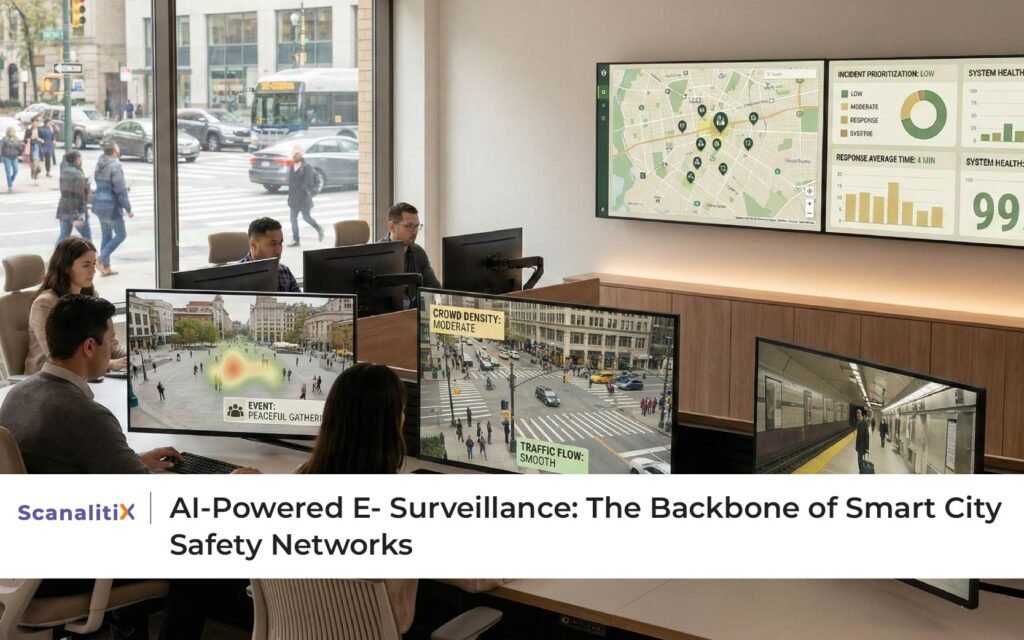
Table of Contents
Cities are growing faster than ever. By 2030, nearly 60 percent of the world’s population is expected to live in urban areas. With this growth comes opportunity, but also complexity. Traffic congestion, public safety risks, emergency response delays, and infrastructure strain are daily realities for city administrators. Traditional methods of city monitoring, built on manual oversight and fragmented systems, can no longer keep up.
This is where AI-powered surveillance steps in. It has become the backbone of modern smart city safety networks, enabling authorities to monitor urban environments in real time, respond faster to incidents, and make data-driven decisions that improve both safety and quality of life.
Unlike conventional CCTV systems that simply record footage, AI-powered surveillance analyzes what it sees. It detects patterns, identifies anomalies, and provides actionable intelligence across traffic systems, public spaces, transport hubs, and critical infrastructure. In short, it turns cities from reactive entities into proactive, intelligent ecosystems.
Why Smart Cities Need Smarter Surveillance
Urban safety is no longer just about crime prevention. Cities must manage traffic flow, prevent accidents, respond to emergencies, monitor public gatherings, and ensure citizen well-being, often simultaneously. Each of these functions generates massive volumes of data from cameras, sensors, and connected devices.
According to the United Nations, cities already account for more than 70 percent of global CO₂ emissions and consume over two-thirds of the world’s energy. Managing such dense, complex systems requires continuous visibility. However, human monitoring alone cannot process the scale or speed of data generated across a city.
AI-powered surveillance bridges this gap. By combining computer vision, machine learning, and real-time analytics, it allows cities to detect risks early, prioritize responses, and coordinate across departments. This shift is critical in environments where seconds can determine outcomes, such as traffic accidents, fires, or crowd emergencies.
A report by the World Economic Forum highlights that smart surveillance systems can significantly reduce response times and improve situational awareness, especially in densely populated urban areas. That capability makes AI surveillance not just an enhancement, but a necessity for smart cities.
From Cameras to Intelligence: How AI Transforms Urban Monitoring
Traditional city surveillance relies heavily on human operators watching multiple camera feeds. This approach is prone to fatigue, missed events, and delayed responses. AI changes this fundamentally.
With AI-powered video analytics, cameras act as intelligent sensors. They continuously analyze visual data to detect unusual behavior, crowd build-ups, traffic violations, abandoned objects, or restricted-area breaches. Instead of flooding control rooms with raw footage, AI systems generate prioritized alerts that demand attention.
For example, in traffic management, AI can detect congestion patterns, signal violations, wrong-way driving, or stalled vehicles. In public spaces, it can identify overcrowding or unusual movement patterns that may indicate a potential safety issue. In critical infrastructure zones, it can flag unauthorized access attempts instantly.
According to MarketsandMarkets, the global video analytics market is expected to grow rapidly, driven largely by smart city deployments. The report notes that AI-based surveillance significantly improves detection accuracy while reducing false alarms, making it suitable for large-scale urban environments.
Enhancing Public Safety and Crime Prevention
Public safety remains a central pillar of smart city initiatives. AI-powered surveillance strengthens this pillar by enabling predictive and preventive policing.
Instead of responding after incidents occur, authorities can use analytics to identify high-risk zones and time periods. Pattern recognition helps uncover trends such as repeated vandalism in certain areas, unusual nighttime activity, or frequent traffic violations at specific intersections.
A study published by the National Institute of Justice highlights how data-driven surveillance and analytics improve crime prevention by supporting targeted patrols and faster intervention. AI surveillance provides the visual intelligence that feeds these data-driven strategies.
Importantly, modern systems are designed to focus on behavior and movement patterns rather than personal profiling. When combined with clear governance and ethical frameworks, AI surveillance enhances safety while respecting citizen privacy.
Traffic Management and Road Safety
One of the most visible impacts of AI-powered surveillance in smart cities is traffic management. Urban congestion costs economies billions annually in lost productivity and fuel. At the same time, road accidents remain a leading cause of injury and death worldwide.
AI surveillance systems monitor intersections, highways, and arterial roads in real time. They detect traffic density, accidents, signal violations, and pedestrian movement. This data enables adaptive signal control, faster incident clearance, and safer road design.
The World Bank reports that intelligent transport systems, including AI-based video analytics, can reduce travel time by up to 20 percent and significantly improve road safety. Cities using these systems gain the ability to respond dynamically rather than rely on static traffic plans.
By integrating traffic surveillance into centralized command centers, smart cities ensure that traffic police, emergency responders, and municipal authorities operate with a shared, real-time view of road conditions.
Crowd Management and Emergency Response
Large public gatherings, festivals, protests, and transit hubs present unique safety challenges. Managing crowd density and movement is critical to preventing stampedes, panic, or delays in emergency response.
AI-powered surveillance plays a vital role here. Video analytics can estimate crowd density, detect abnormal movement patterns, and identify potential bottlenecks. When thresholds are exceeded, systems alert authorities to take preventive action, such as redirecting foot traffic or deploying additional personnel.
During emergencies, integrated surveillance ensures faster response. Cameras, sensors, and communication systems feed into a centralized command and control center, enabling authorities to coordinate police, fire, and medical services effectively.
According to research published by the International Association of Chiefs of Police, real-time situational awareness supported by video analytics significantly improves emergency response outcomes in urban environments.
Centralized Command and Control: The Heart of Smart City Safety
AI-powered surveillance delivers its full value when integrated into centralized command and control centers. These centers act as the city’s nerve hub, consolidating data from multiple systems into a single operational view.
Such centers monitor traffic, public safety, utilities, and environmental data simultaneously. AI prioritizes alerts based on severity, enabling faster decision-making. This integrated approach reduces departmental silos and ensures coordinated action.
India’s Smart Cities Mission has emphasized the role of Integrated Command and Control Centers (ICCCs) as foundational infrastructure. Many Indian cities now rely on AI-enabled surveillance within these centers to manage daily operations and emergencies more effectively.
Efficiency, Sustainability, and Better Urban Living
Beyond safety, AI-powered surveillance contributes to operational efficiency and sustainability. By analyzing movement patterns, cities can optimize public transport routes, reduce congestion, and lower emissions. Monitoring infrastructure health helps prevent failures and reduces maintenance costs.
McKinsey research on smart cities shows that data-driven urban management can improve key quality-of-life indicators by 10 to 30 percent. Surveillance analytics, when used responsibly, are a critical part of this transformation.
The ability to measure, analyze, and act on real-time data helps cities become more livable, resilient, and citizen-centric.
The Road Ahead: Responsible and Predictive Urban Surveillance
The future of smart city surveillance lies in prediction rather than detection alone. As AI models mature, systems will anticipate risks by combining video analytics with IoT sensors, historical data, and environmental inputs.
However, this future must be built on trust. Transparent policies, strong data governance, and ethical AI practices are essential. Surveillance should empower cities while safeguarding citizen rights.
When implemented responsibly, AI-powered surveillance becomes a force multiplier for safety, efficiency, and resilience.
Conclusion
Smart cities require smart safety networks. AI-powered surveillance has emerged as the backbone of these networks, enabling cities to see clearly, respond faster, and plan better.
By transforming cameras into intelligent systems, cities gain real-time awareness across traffic, public spaces, and critical infrastructure. They move from reactive responses to proactive governance. Most importantly, they create safer, more efficient urban environments for their citizens.
As cities continue to grow, AI-powered surveillance will remain central to building urban futures that are secure, sustainable, and human-centric.