
AI as a Co-Worker, Not a Competitor: The Future of Employability in the Age of AI
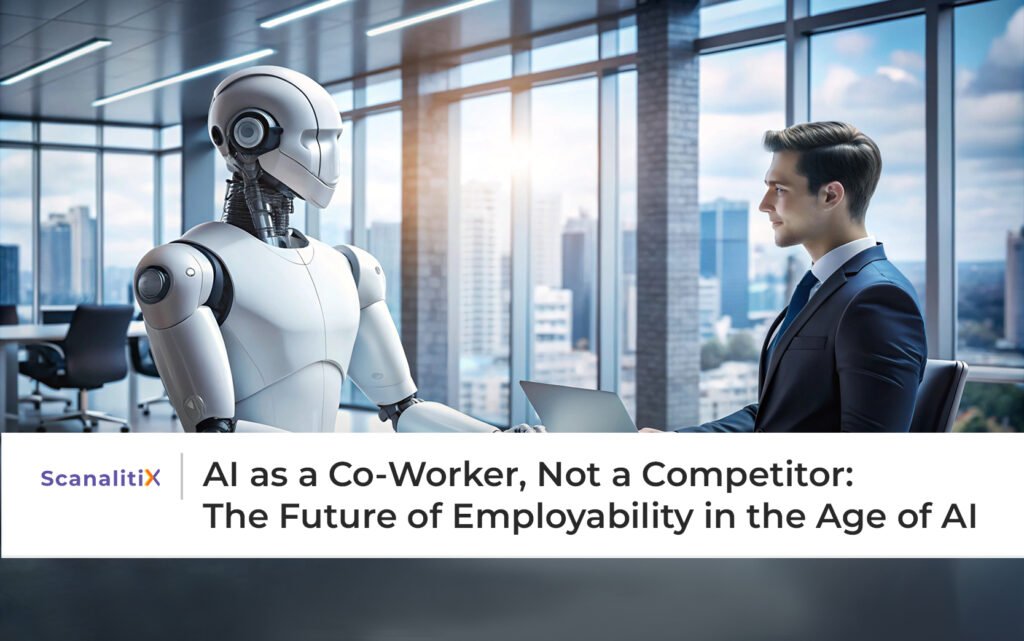
The narrative around Artificial Intelligence has long been dramatic. Headlines often frame it as a looming threat to jobs, a force poised to replace human workers across industries. However, as the technology matures and real-world deployments increase, a more nuanced truth is emerging. AI is not simply replacing workers. In many cases, it is reshaping roles, augmenting skills, and creating entirely new career paths.
The future of employability in the age of AI will not be defined by competition between humans and machines. It will be defined by collaboration.
Understanding this shift is essential for organizations, professionals, and policymakers navigating industry transformation.
The Fear of Job Displacement: What the Data Actually Says
Concerns about automation replacing jobs are not new. From industrial machinery to robotics, every technological wave has triggered similar anxieties. AI, however, feels different because it extends beyond physical labor into cognitive tasks.
A widely cited report by the World Economic Forum estimates that while AI and automation could displace around 85 million jobs globally by 2025, they are also expected to create approximately 97 million new roles better suited to the new division of labor between humans and machines. The net effect suggests transformation rather than elimination.
Similarly, McKinsey & Company reports that while up to 30 percent of work activities could be automated by 2030, very few occupations will be fully automated. Instead, most jobs will evolve, with AI handling repetitive tasks while humans focus on higher-value decision-making, creativity, and emotional intelligence.
These findings shift the conversation from job loss to job redesign.
AI is not removing work entirely. It is removing specific tasks within jobs, particularly those that are repetitive, predictable, and rule-based.
AI Augmentation: The Rise of Human-AI Collaboration
The concept of AI augmentation is central to understanding the future of work. Rather than replacing employees, AI systems enhance human capability.
In healthcare, AI assists radiologists by analyzing scans faster and highlighting anomalies, but doctors make the final diagnosis. In finance, AI models detect suspicious transactions, while compliance officers assess risk and take action. In manufacturing, predictive analytics identify maintenance needs, while engineers implement corrective measures.
Research published by the MIT Sloan Management Review emphasizes that organizations gain the most value when AI complements human strengths instead of substituting them. Machines excel at pattern recognition, data processing, and scalability. Humans excel at judgment, empathy, strategic thinking, and adaptability.
The most resilient workforce is one where AI acts as a co-worker, not a competitor.
Industry Transformation in the Age of Artificial Intelligence
AI-driven industry transformation is already visible across sectors.
In retail, AI-powered analytics optimize inventory management, customer insights, and demand forecasting. According to Deloitte, retailers using AI-driven insights have improved operational efficiency and personalized customer engagement significantly.
In logistics and supply chains, AI enhances route planning, predictive maintenance, and warehouse automation. The World Economic Forum highlights that digital technologies, including AI, improve supply chain resilience and reduce operational disruptions.
In banking and financial services, AI strengthens fraud detection and risk assessment. IBM reports that AI-based fraud detection systems identify suspicious patterns far more accurately than rule-based systems, reducing false positives and improving compliance efficiency.
Across smart cities and infrastructure, AI supports traffic optimization, public safety monitoring, and energy management.
In each case, AI does not eliminate the human role. It changes it. Employees shift from manual monitoring to strategic oversight, from repetitive execution to intelligent supervision.
Job Displacement vs Job Creation: A Skills Perspective
The real disruption of AI lies in skills.
The World Economic Forum’s Future of Jobs Report indicates that analytical thinking, creativity, technology literacy, and resilience will become increasingly valuable skills in the AI-driven economy. Routine manual and clerical tasks are more vulnerable to automation.
However, new roles are emerging rapidly. AI specialists, data analysts, machine learning engineers, cybersecurity experts, and digital operations managers represent some of the fastest-growing professions globally.
LinkedIn’s Emerging Jobs Report consistently highlights AI-related roles among the top growth categories. Even non-technical roles now require digital fluency and data interpretation skills.
This shift underscores a critical insight: employability in the age of AI depends less on competing with machines and more on learning to work alongside them.
Reskilling and upskilling become central strategies. Organizations that invest in workforce development are better positioned to harness AI’s benefits without leaving employees behind.
Productivity Gains and Economic Growth
Beyond individual roles, AI contributes to broader economic productivity.
PwC estimates that AI could contribute up to $15.7 trillion to the global economy by 2030 through productivity gains and increased consumer demand. These gains come from automation of routine tasks, enhanced decision-making, and innovation acceleration.
However, productivity growth alone does not guarantee equitable outcomes. Without thoughtful implementation and workforce planning, certain sectors or demographics may face disproportionate impact.
This is why responsible AI adoption must go hand in hand with inclusive employment strategies.
AI should enable people to focus on work that requires uniquely human qualities. When deployed responsibly, it enhances both economic growth and job quality.
The Ethical and Human Dimension of AI in the Workplace
Trust plays a vital role in human-AI collaboration.
Employees are more likely to embrace AI tools when they understand their purpose and limitations. Transparency in how AI systems make decisions is critical. The European Commission’s guidelines on trustworthy AI emphasize accountability, explainability, and fairness as foundational principles.
Organizations must ensure that AI systems augment human judgment rather than override it blindly. Clear governance, ethical frameworks, and training programs help build confidence.
When employees see AI as a tool that simplifies workflows, reduces errors, and supports smarter decisions, resistance diminishes.
The future of work depends as much on culture as on code.
AI in Surveillance and Intelligent Operations: A Practical Example
One of the most visible examples of AI acting as a co-worker is in surveillance and operational monitoring.
Traditional rule-based surveillance systems required human operators to watch multiple screens continuously. This approach was prone to fatigue and missed alerts. AI-based analytics now assist by detecting anomalies, reducing false alarms, and prioritizing incidents.
Instead of replacing security teams, AI supports them. It filters noise, highlights meaningful risks, and allows personnel to focus on investigation and resolution.
This shift mirrors the broader transformation across industries. AI handles pattern recognition at scale. Humans apply contextual judgment and take decisive action.
Where Scanalitix Fits In
Scanalitix reflects the philosophy that AI should empower professionals rather than replace them.
By combining AI-powered video analytics, centralized monitoring, and workflow management, Scanalitix transforms surveillance operations from reactive observation to intelligent collaboration. The platform processes vast volumes of visual data, detects anomalies in real time, and routes actionable insights to the right teams.
Security personnel and operations managers remain at the center of decision-making. AI serves as a digital co-worker, enhancing situational awareness and reducing operational fatigue.
This approach aligns with the broader future of employability in the age of AI. Technology amplifies human capability. It does not diminish it.
Conclusion: The Future Is Collaborative
The debate around AI and jobs often focuses on replacement. However, the evidence suggests transformation is the more accurate lens.
AI will automate tasks, not eliminate human value. It will create new roles while redefining existing ones. Industries will evolve, requiring adaptability, digital literacy, and continuous learning.
The organizations that thrive will be those that treat AI as a partner in productivity and innovation. The professionals who succeed will be those who cultivate uniquely human strengths while leveraging intelligent tools.
AI as a co-worker is not a distant vision. It is already shaping the present.
The future of employability belongs to collaboration.