
5 Ways AI Cameras Are Replacing Traditional Security in 2026
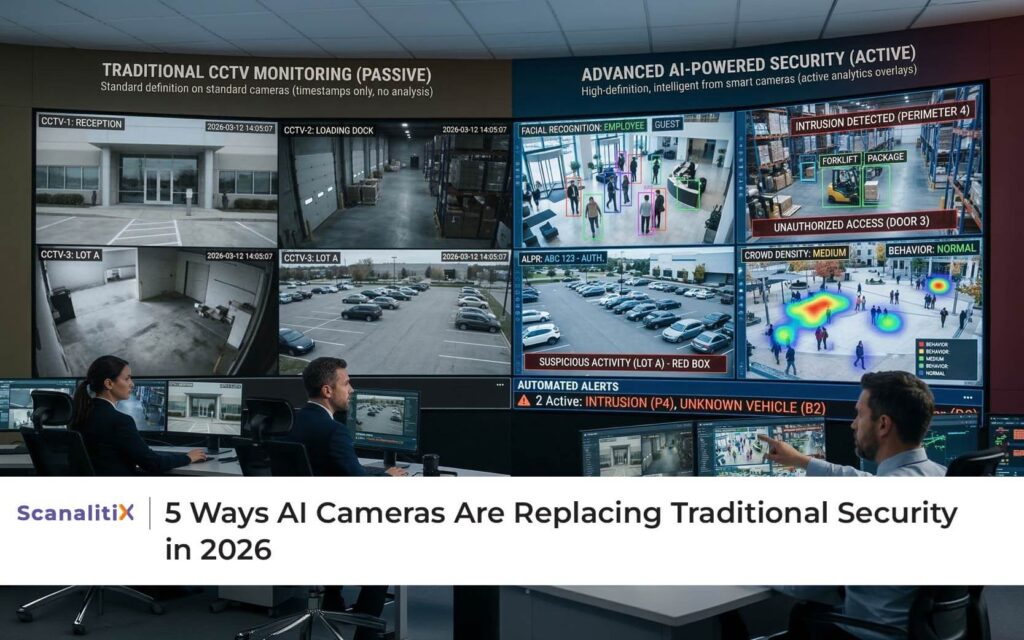
Are Security Cameras Still Just Recording Devices or Have They Become Decision-Makers?
What if your security camera could think, analyze, and respond, without waiting for human intervention? What if it could detect threats before they escalate, track suspicious behavior across locations, and even trigger automated actions in real time?
In 2026, this is no longer a “what if.” AI-powered cameras are rapidly replacing traditional security systems, transforming surveillance from passive monitoring into proactive intelligence.
The shift is clear: from recording incidents to preventing them.
The Evolution of Security: Why AI Cameras Are Taking Over
The global video analytics market is expanding at an unprecedented pace, driven by demand for smarter surveillance systems.
- The AI video analytics market is projected to reach USD 6.19 billion in 2026, growing at a CAGR of over 22%
- The broader video analytics market is expected to hit USD 37.84 billion by 2030, fueled by smart city and enterprise adoption
This rapid growth reflects a fundamental reality: traditional security systems can no longer keep up with the complexity and speed of modern threats.
- From Passive Monitoring to Proactive Threat Detection
Traditional Security:
- Records footage for later review
- Relies heavily on human monitoring
- Delayed response to incidents
AI Cameras:
- Detect anomalies in real time
- Identify suspicious behavior (loitering, intrusion)
- Trigger instant alerts and actions
AI cameras use computer vision and deep learning to continuously analyze live video feeds. Instead of waiting for an incident to occur, they predict and prevent risks before they escalate.
Impact: Faster response times, reduced human dependency, and enhanced situational awareness.
- Real-Time Alerts vs. Post-Incident Investigation
Traditional systems are designed for forensics. AI systems are built for intervention.
What Changes?
- AI cameras can instantly notify security teams about:
- Unauthorized access
- Perimeter breaches
- Suspicious movement patterns
- Alerts are contextual, not just motion-based
- Systems can integrate with alarms, access control, and emergency protocols
This real-time intelligence enables organizations to act within seconds—not hours.
Result: Security shifts from reactive investigation to proactive response.
- BehaviorAnalysis: Understanding Intent, Not Just Movement
One of the biggest limitations of traditional surveillance is its inability to interpret human behavior.
AI cameras change that.
Capabilities Include:
- Crowd behavior analysis
- Detection of unusual patterns (running, loitering, clustering)
- Identification of potential threats based on movement patterns
For example, in public spaces, AI can detect early signs of panic or aggression—helping authorities intervene before situations escalate.
This is where AI security becomes predictive, not just observational.
- Edge AI: Intelligence BuiltIntothe Camera
In 2026, the camera itself has become the computing unit.
Traditional Model:
- Video sent to centralized servers
- High latency and bandwidth usage
AI Camera Model:
- Processing happens at the edge (on-device)
- Instant decision-making
- Reduced reliance on cloud infrastructure
Edge AI enables:
- Millisecond-level responses
- Enhanced data privacy
- Lower operational costs
This is particularly critical for industries like transportation, manufacturing, and defense-where delays can have serious consequences.
- From Isolated Systems to a Unified Intelligence Network
Traditional security systems operate in silos-each camera, each system functioning independently.
AI cameras, however, are part of a connected ecosystem.
What This Means:
- Cameras communicate with each other
- Data is integrated across multiple locations
- Insights are centralized and actionable
This creates a Unified E-Surveillance Ecosystem, where:
- A suspicious individual tracked at one entry point can be followed across an entire facility
- Security teams gain a holistic, real-time view of operations
- Decision-making becomes faster and more informed
This level of integration is impossible with legacy systems.
Industry Use Cases: Where AI Cameras Are Making the Biggest Impact
Smart Cities
AI cameras are transforming urban infrastructure by:
- Managing traffic flow
- Detecting accidents instantly
- Monitoring public safety
Cities are evolving into intelligent ecosystems powered by real-time video insights.
Retail and Commercial Spaces
Retailers are leveraging AI cameras to:
- Prevent theft
- Analyze customer behavior
- Optimize store layouts
Security is no longer just about loss prevention-it’s about enhancing customer experience.
Manufacturing and Industrial Sites
AI cameras help:
- Monitor worker safety
- Detect compliance violations
- Identify operational inefficiencies
This reduces downtime and improves workplace safety.
Banking and Financial Institutions
Banks use AI cameras for:
- Fraud detection
- ATM surveillance
- Real-time threat alerts
This ensures faster response to suspicious activities and minimizes risk.
Challenges to Consider
While AI cameras offer significant advantages, adoption comes with challenges:
Data Privacy Concerns
With increased surveillance comes increased responsibility. Organizations must:
- Ensure compliance with regulations
- Protect user data
- Maintain transparency
Integration Complexity
Migrating from traditional systems to AI-driven infrastructure requires:
- Upgraded hardware
- Skilled expertise
- Seamless system integration
Accuracy and Bias
AI models must be continuously trained to avoid:
- False positives
- Misidentification
- Operational inefficiencies
The Future: Autonomous Security Systems
The next phase of security isn’t just intelligent-it’s autonomous.
AI cameras are evolving to:
- Take independent decisions
- Automate responses
- Predict risks before they emerge
- Imagine a system that:
- Locks down access points automatically
- Alerts authorities instantly
- Adjusts security protocols dynamically
This is not science fiction- it’s the direction security is heading.
Final Thoughts
So, are traditional security systems becoming obsolete?
In many ways, yes.
AI cameras are not just replacing legacy systems-they are redefining what security means. From real-time intelligence to predictive insights, they are enabling organizations to move from watching incidents to preventing them entirely.
In 2026, security is no longer about cameras.
It’s about intelligence, speed, and the ability to act-before it’s too late.