
24x7 Vigilance: The Role of Centralized Monitoring in Multi-Branch Bank Operations
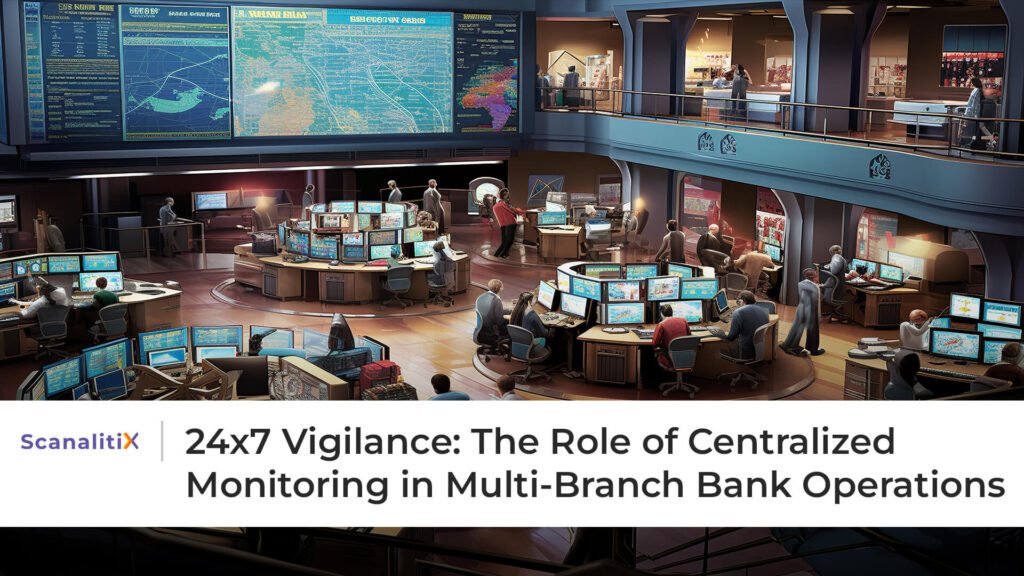
Table of Contents
Modern banking never sleeps. Customers expect uninterrupted access to ATMs, seamless transactions, secure branches, and responsive services across locations. Whether a bank operates 50 branches or 5,000, one reality remains unchanged: the entire network must stay safe, compliant, and fully functional round the clock.
However, the scale and complexity of multi-branch operations make this extremely challenging. Each branch has its own environment, risk profile, visitor behaviour, cash movement schedules, on-site staff, and operating conditions. ATMs sit in unattended kiosks, business correspondent outlets operate across rural belts, and data centres carry critical loads.
In such an environment, security and operational control cannot depend on standalone CCTV systems or siloed branch-level vigilance. That era is over.
Banks today require centralized monitoring systems that create a unified, real-time view of every branch, ATM, kiosk, vault, service zone, and field team. Centralization is not just a technological upgrade; it is now a strategic imperative for both safety and operational continuity.
Why Banks Need 24x7 Centralized Monitoring
Multi-branch networks operate at scale. If each location reports independently, visibility becomes fragmented. Issues slip through cracks. Response times increase. Compliance becomes inconsistent. And risk multiplies.
Banks face a distinct set of challenges:
- Distributed Risk: Branches face threats such as intrusions, vandalism, ATM skimming, property breaches, and internal fraud. Without unified monitoring, identifying patterns across branches becomes nearly impossible.
- High-Value, High-Liability Assets: Banks handle cash, gold, lockers, customer data, and sensitive documents. Any lapse in monitoring exposes the institution to reputational and financial risk.
- Regulatory Pressure: RBI and global financial governance frameworks mandate strict evidence retention, access control, and surveillance protocols. A central command centre ensures all branches follow the same compliance playbook.
- Increasing Footfall and 24×7 Self-Service Zones: ATMs, cash recyclers, vestibules, digital kiosks, and bank-mitra points operate without staff. These zones need constant supervision even when branches are closed.
- Rising Incidents of ATM Crime: According to multiple industry reports, ATM breaches, jackpotting attempts, card cloning, and kiosk vandalism continue to rise. Vigilance at scale is critical.
All these realities point in one direction: a bank cannot safeguard distributed assets from distributed control rooms. It needs a single source of truth.
What Centralized Monitoring Actually Means
Centralized monitoring brings all security, operational, and surveillance data into one integrated command centre. Instead of branches managing their own alerts, the command centre monitors everything:
- All CCTV cameras
- ATM cameras and sensors
- UPS and power systems
- Vault access logs
- Panic alarms
- Branch open-close protocols
- Cash replenishment activity
- Fire detection systems
- Field staff activity
- IoT sensors for temperature, humidity, vibration
- Behavioural analytics and intrusion detection
This creates an ecosystem where one team can watch, interpret, and respond across the entire banking network. Centralized monitoring introduces consistency, speed, intelligence, and total visibility.
How Centralized Monitoring Works: A Layered Approach
Banks typically deploy a four-layered intelligence model for 24×7 vigilance. Each layer adds clarity, automation, and control.
Layer 1: Video Management System (VMS)
This is the foundation. All video feeds from branches, ATMs, kiosks, and off-site locations, stream into a single platform. It ensures:
- Uniform video quality
- Consistent recording policies
- Easy retrieval for audits or investigations
- Central storage or hybrid cloud management
- Secure data access
Layer 2: AI-Powered Video Analytics
This is where intelligence enters the system. Instead of reviewing footage manually, banks depend on analytics to detect:
- Unusual activity after branch hours
- People loitering around ATMs
- Masked individuals entering sensitive zones
- Repeated failed ATM transactions
- Forced entry attempts
- Suspicious vehicles circling branches
- Crowd build-up at ATMs
- Restricted area violations
- Customer aggression or altercations
AI helps the monitoring team focus only on real events.
Layer 3: Central Monitoring System (CMS)
This system receives and prioritizes alerts. It ensures:
- 24×7 incident monitoring
- Ticket creation for every alert
- SLA-driven response
- Escalations based on severity
- Coordination with branch staff or field teams
- End-to-end incident closure
Layer 4: Field Management System (FMS)
Once the system identifies an issue, FMS assigns it to the nearest field personnel. It tracks:
- Who accepted the task
- Time taken to reach the location
- Actions taken
- Closure proof (photos, videos, geo-tags)
These layers work together to create a complete vigilance ecosystem.
What Banks Gain From a Centralized Monitoring Model
Centralized monitoring is not just about preventing break-ins. It enhances every part of multi-branch banking.
- Uniform Security Policies Across All Branches: Banks operate in diverse environments, from metro cities to rural towns. Centralized monitoring ensures each location follows consistent surveillance, access, and safety standards.
- Faster Incident Detection and Response: Every second matters during an intrusion or fire. With a dedicated command centre:
- Alerts are immediate
- Responses are coordinated
- Field staff reach the site faster
- Losses reduce dramatically
- End-to-End Auditability – With a single platform, banks maintain:
- Digital logs
- Tamper-proof evidence
- Incident timelines
- Automated reporting
This simplifies RBI audits, insurance claims, and compliance checks.
- Cross-Branch Intelligence – Patterns emerge only when data is aggregated. Centralized monitoring finds trends across branches:
- Repeated ATM tampering in certain geographies
- Perimeter breaches at specific time windows
- Similar behaviour across unrelated theft attempts
This helps banks act proactively rather than reactively.
- Reduced Operational Costs – Banks save money by:
- Minimizing physical security dependency
- Preventing losses from ATM or branch damage
- Eliminating redundant monitoring rooms
- Reducing false alarms
- Safer Customer Environments – With faster response, the bank ensures:
- Safer ATM visits
- Secure locker operations
- Controlled branch entry/exit
- Reduced risk of fraud or aggression
Customer trust increases when branches operate with visible vigilance.
The Hidden Advantage: Operational Intelligence
Centralized monitoring is not limited to security. It provides insights into daily operations.
Analytics reveal patterns such as:
- ATM uptime vs downtime
- Branch opening delays
- Staff efficiency alerts
- Housekeeping quality
- Visitor footfall patterns
- Underperforming counters
- Power or UPS failures
Banks can review these insights to improve efficiency, reduce expenses, and increase profitability.
This transforms surveillance from a cost centre into an operational intelligence engine.
Case Examples and Global Parallels
Centralized monitoring has become a global norm in BFSI operations.
- US & European Banks – Major banks use unified Security Operation Centers (SOCs) to monitor locations across states. They rely heavily on:
- AI-based intrusion detection
- Behaviour analytics
- Integrated alarm-video workflows
This ensures 24×7 vigilance even when branches are unstaffed.
- Middle East Financial Institutions – Banks across the UAE, Qatar, and Saudi Arabia deploy centralized command rooms to monitor:
- Remote ATMs
- Gold vaults
- Forex counters
- High-value customer lounges
Video analytics here plays a critical role in risk scoring and compliance.
- Indian BFSI Sector (Rapid Adoption) – Indian banks, especially those with large rural footprints, have adopted centralized monitoring for:
- ATM skimming prevention
- Cash replenishment alerts
- Branch trespassing detection
- Fire and electrical risk monitoring
Public-sector and private-sector banks alike have benefited from eliminating fragmented monitoring systems.
Why Scanalitix Is Built for Multi-Branch BFSI Monitoring
Scanalitix combines VMS, CMS, advanced analytics, and field management into one unified platform. This creates an end-to-end ecosystem where:
- Every camera feed integrates seamlessly
- Every alert flows through a central workflow
- Every incident is tracked from trigger to closure
- Every response is logged with proof
- Every branch stays under 24×7 centralized vigilance
Scanalitix is built specifically for complex, distributed operations. For banks, this means:
- No more separate monitoring rooms
- No more manual alert triaging
- No more missed incidents
- No more inconsistent security protocols
A bank with 1,000 branches can operate with the same vigilance as a bank with 10,000 — all with a single unified command centre.
Conclusion
24×7 centralized monitoring is no longer optional for multi-branch banks. Distributed vigilance creates distributed blind spots. Centralization converts complexity into clarity. It strengthens security, enhances compliance, reduces operational risk, and improves customer trust.
Modern banking requires more than cameras. It requires intelligence. It requires integration. It requires an ecosystem that sees everything, connects everything, and acts instantly.
Centralized monitoring is the backbone of secure multi-branch operations. With platforms like Scanalitix, banks finally have the ability to operate with the vigilance of a single branch across hundreds of locations.